You reformatted your resume. Single column, no tables, no icons, standard headings, keywords lifted from the job description.
You did that because 75% of resumes are rejected by the ATS before a human sees them.
That number is fake. It came from 2012 marketing material by a company called Preptel, which shut down in 2013. No dataset was ever published. No methodology was ever published. When recruiters were asked where they first heard it, 68% said from job seekers on social media, and another 20% blamed career coaches recycling it.
Meanwhile there is a real problem with algorithmic screening, Stanford measured it across 4 million applications, and it has nothing to do with your formatting. It is worse, and almost nobody is talking about it.
First, the myth
92% of recruiters say their applicant tracking system does not automatically reject resumes based on formatting, design or content. Filters are used to prioritise and sort, not to eliminate.
So why do applications vanish? Volume. High-demand roles attract 400 to more than 2,000 applicants within days. Nobody read yours because there were nineteen hundred others, not because a script objected to your two-column layout.
The one formatting-adjacent thing that does hold up: resumes carrying keywords pulled directly from the job description are 40% more likely to be selected for human review. That is a real effect, and note what it means. A human is doing the selecting. The keywords help you get surfaced, not past a gate.
Real gatekeeping does happen, but through knockout questions, the explicit ones. Do you have a valid work permit. Do you have five years of experience. Those are filters you can see and answer honestly, and they are nothing like a hidden robot judging your font.
The 75% figure has no dataset, no methodology, and no surviving author. It is a dead company's sales pitch that job seekers have been passing to each other for fourteen years.
Now, the real problem
Stanford HAI published this on 26 May 2026. Rishi Bommasani, Sarah H. Bana, Kathleen A. Creel, Dan Jurafsky and Percy Liang studied:
- 4 million job applications
- from 3.4 million people
- to 1,700 job postings
- across 150 employers
- in 11 industry sectors
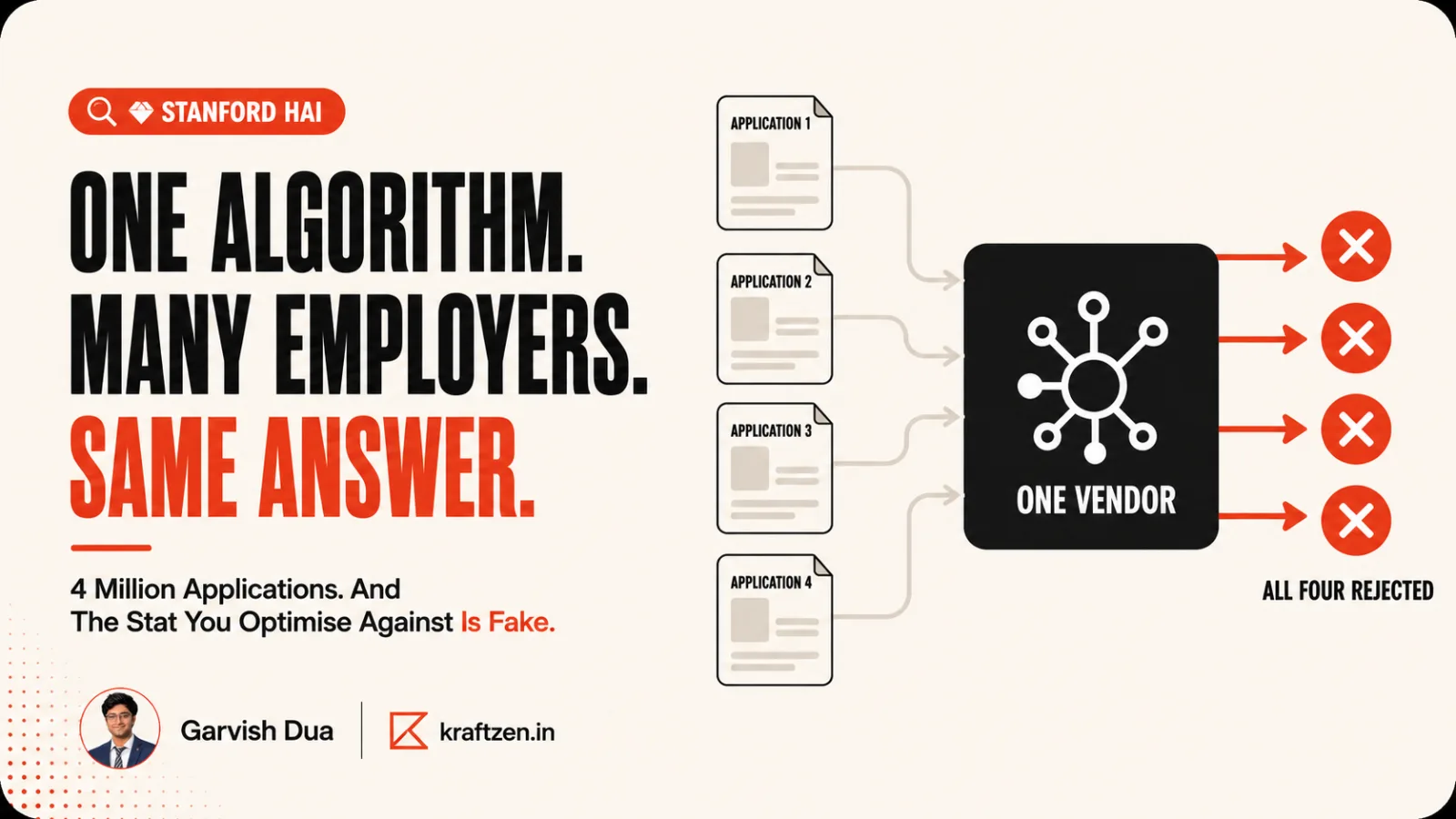
- all assessed by one third-party screening vendor
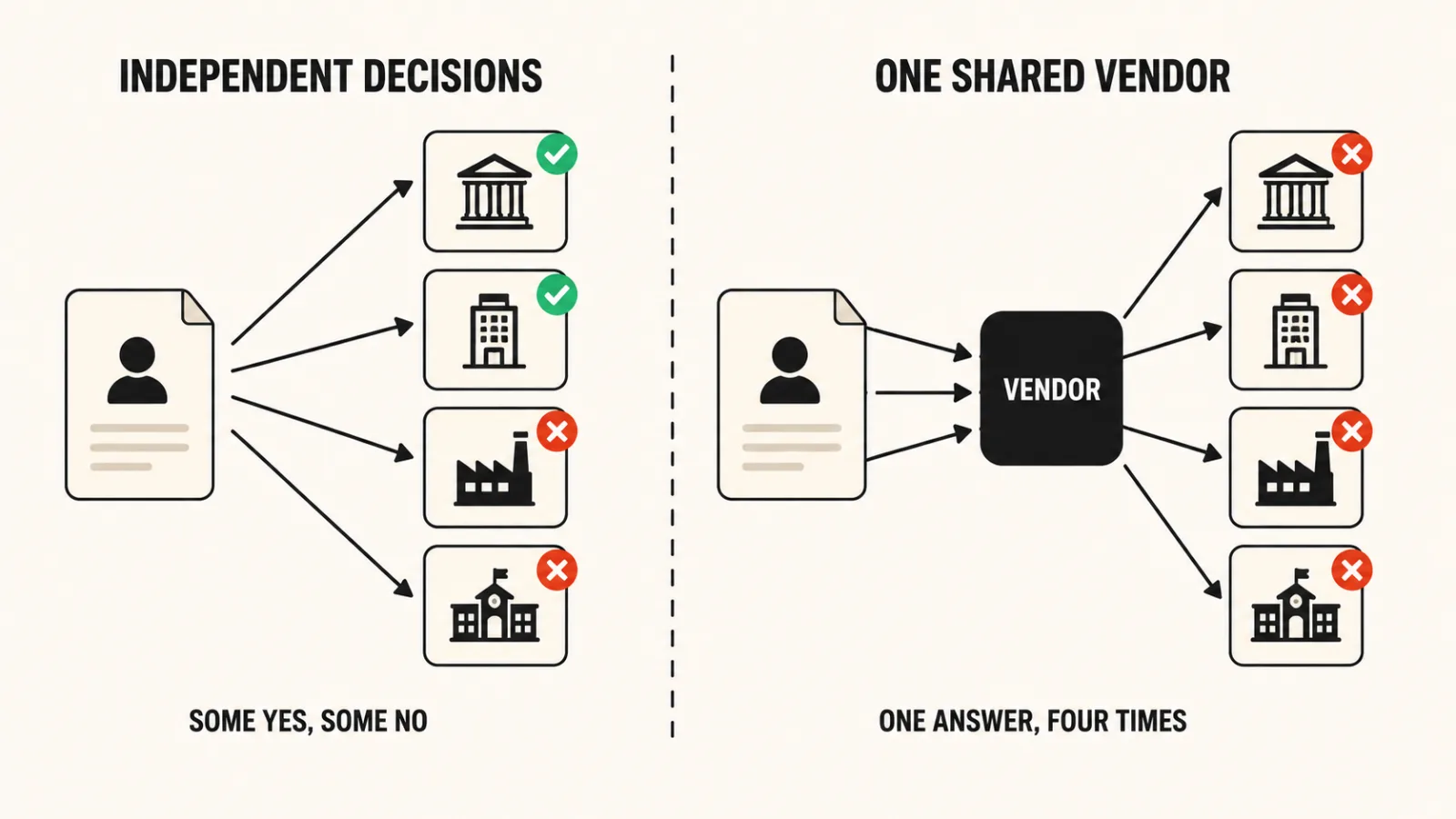
Here is the finding. Ten percent of applicants who submit four applications are rejected from every single one.
Not "rejected more often". Rejected everywhere.
Why that number should bother you
If 150 employers each made their own decision, rejections would be roughly independent. Bad luck at one company would tell you almost nothing about your odds at the next. Apply to enough places and the maths eventually works for you. That is the entire premise of "it's a numbers game".
When they all buy the same screening vendor, the decisions stop being independent. The same model, weighted the same way, looks at the same resume and reaches the same conclusion. Four applications through one vendor is not four assessments. It is closer to one assessment, repeated and billed four times.
The researchers call this a monoculture effect, and the term is well chosen. A field planted with one variety fails all at once for the same reason.
For you, the practical damage is that applying more does not help in the way you have been told it does, as long as you stay inside the same vendor's footprint.
The bias finding
The same study measured adverse impact using the EEOC's four-fifths rule, the standard used under Title VII, and assessed it position by position rather than by pooling all of the vendor's data. Pooling hides it, which is part of the point.
26% of Black applicants and 15% of Asian applicants applied to positions where the system discriminated against their racial group.
The counterfactual the authors ran: if recommendation rates had matched the most-favoured group's rate, 40,000 more applications would have advanced to the next stage.
That is not 40,000 people who would definitely have been hired. It is 40,000 applications that would have reached a human being. The monoculture makes this worse in the obvious way, because a single skewed model applied across 150 employers spreads one bias everywhere instead of averaging several out.
Lawsuits against screening vendors are working through California courts now, so the legal position may change. Your job search will not wait for it.
Myth against measurement
| What you have been told | What the data says |
|---|---|
| 75% of resumes are auto-rejected by the ATS | No source. 2012 marketing by a company that closed in 2013 |
| The ATS throws out your resume for formatting | 92% of recruiters manually review; filters sort rather than eliminate |
| Applying to more places improves your odds | Only if the assessments are independent. Inside one vendor they are not |
| Rejection is a signal about your resume | 10% of four-application applicants are rejected everywhere, which is a signal about the system |
| Keywords beat the robot | Keywords raise your odds of human review by 40%. A person still decides |
What to actually do
Vary the vendor, not just the company. This is the one genuinely new tactic in this post. If several applications go through the same screening product, you are getting one opinion repeatedly. Mix in employers who use a different system, apply through routes that skip the funnel, and treat a run of silent rejections as information about the pipeline rather than about you.
Get referred. A referral usually enters at a different point in the process. This is the oldest advice in job hunting and the monoculture finding is the strongest argument for it anyone has produced in years.
Apply where a human reads first. Smaller companies, direct email to a hiring manager, roles posted by the team rather than by a recruiting platform. Fewer applicants per posting, and no shared model.
Keep the keywords. They work, for a reason that is not what you were told. They increase the chance a person reviews you by 40%.
Stop reformatting. Single column and standard headings are fine and cost you nothing. Beyond that you are solving a problem that 92% of recruiters say does not exist.
Common mistakes
Optimising against the 75% stat. It has no methodology and no surviving author. Hours spent stripping tables out of a resume are hours not spent getting referred.
Reading repeated rejection as feedback. If four rejections came through one vendor, that is close to one rejection. Correlated outcomes feel like a verdict on you and are not.
Applying to more roles at the same large employers. They are the most likely to share a screening vendor. Broadening across employers who buy different tools does more than adding volume inside one.
Assuming a screening vendor is neutral because it is automated. The study found position-level discrimination that pooled reporting hides. Automated means consistent, and consistency spreads a flaw as reliably as it spreads a standard.
Waiting for the lawsuits. Cases against screening vendors are moving through California courts. That may change the market eventually. It will not change your next six months.
Key takeaways
- The claim that 75% of resumes are auto-rejected by an ATS is unsourced. It originated in 2012 marketing from Preptel, which shut down in 2013.
- 92% of recruiters say their system does not auto-reject on formatting or content. Filters prioritise rather than eliminate, and applications vanish because postings draw 400 to 2,000 applicants.
- Stanford HAI, 26 May 2026, studied 4 million applications from 3.4 million people to 1,700 postings across 150 employers, all screened by one vendor.
- 10% of applicants who submit four applications through that vendor are rejected from all four. Decisions stop being independent, so applying more helps less than you think.
- 26% of Black applicants and 15% of Asian applicants applied to positions where the system discriminated against their group. Matching the most-favoured group's rate would have advanced 40,000 more applications.
- Position-by-position analysis using the EEOC four-fifths rule reveals what pooled vendor reporting hides.
- The useful response is to vary the screening vendor rather than only the employer, get referred, and apply where a person reads first.
If you are on the buying side of one of these tools, the position-by-position finding is the part to take to your vendor, because pooled fairness reporting can look clean while individual postings do not. And if you want a shorter list of places to send applications, we went through the platforms one by one, and the wider 2026 hiring picture explains why the queue is so long in the first place.