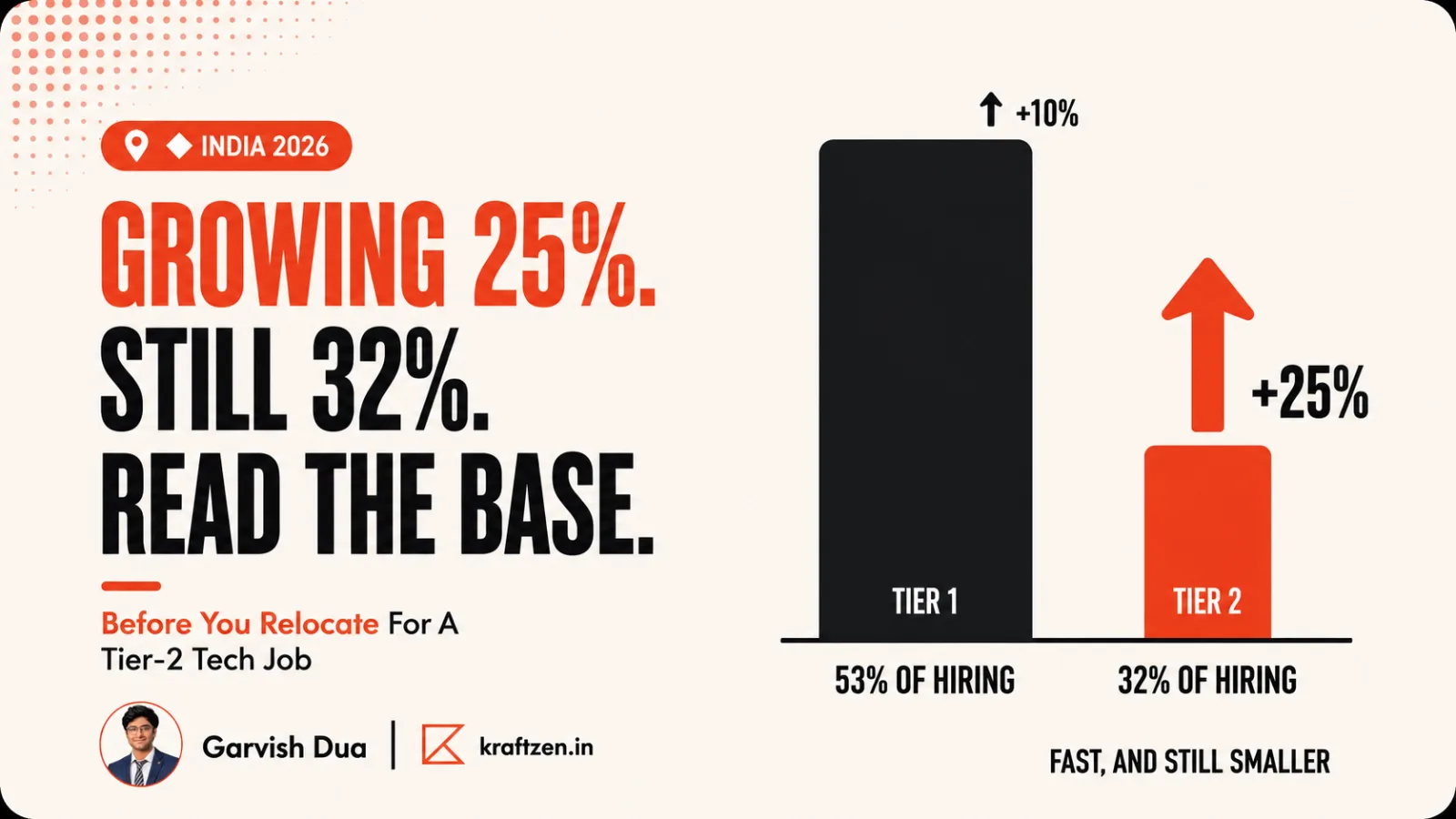
Tier-2 cities grew tech hiring 25% this year. Metros grew 10%.
Every article about this stops at that sentence, and it is the least useful part of the story. A number that small growing quickly and a number that large growing slowly can stay in the same relationship for a decade.
Here is the sentence that should come next: tier-1 still holds 53% of all planned hiring. Tier-2 holds 32%.
Both facts matter, and if you are deciding whether to move for a job, the second one changes the answer more than the first.
The growth is real
None of what follows is an argument that the trend is fake. It is not.
| What is measured | Figure |
|---|---|
| Tier-2 tech hiring growth | 25% |
| Tier-1 tech hiring growth | 10% |
| Tier-2 share of all planned hiring | 32% |
| Tier-1 share of all planned hiring | 53% |
| Rise in tier-2 share of GCCs since 2019 | 40% |
| Cost base versus metros | 25% lower |
| Attrition versus metros | 20 to 30% lower |
| GCCs in India today | about 1,800, roughly $65B revenue |
| Projected by 2030 | about 2,400, over $100B |
Companies are genuinely moving. The direction is not in doubt.
Now read the base
That 40% surge in tier-2 GCC share is the number quoted most often, and it is the one most worth unpacking.
The underlying move is 5% in 2019 to 7% in 2025.
Both descriptions are accurate. Going from 5 to 7 is a 40% relative increase. It is also two percentage points over six years, and it means 93% of GCCs are still not in tier-2 cities.
Which framing you use should depend on what you are deciding. If you are an analyst tracking direction, 40% is the right lens. If you are deciding whether to move your life to Indore for a job, the 7% is what you will actually be living inside, and the number of employers within reach if that job ends is what determines your risk.
Five percent to seven percent is a 40% increase and a two point move. Both are true. Which one matters depends entirely on whether you are describing a trend or making a decision.
Which cities, and for which skills
The growth is not spread evenly, and the specifics are more useful than the trend.
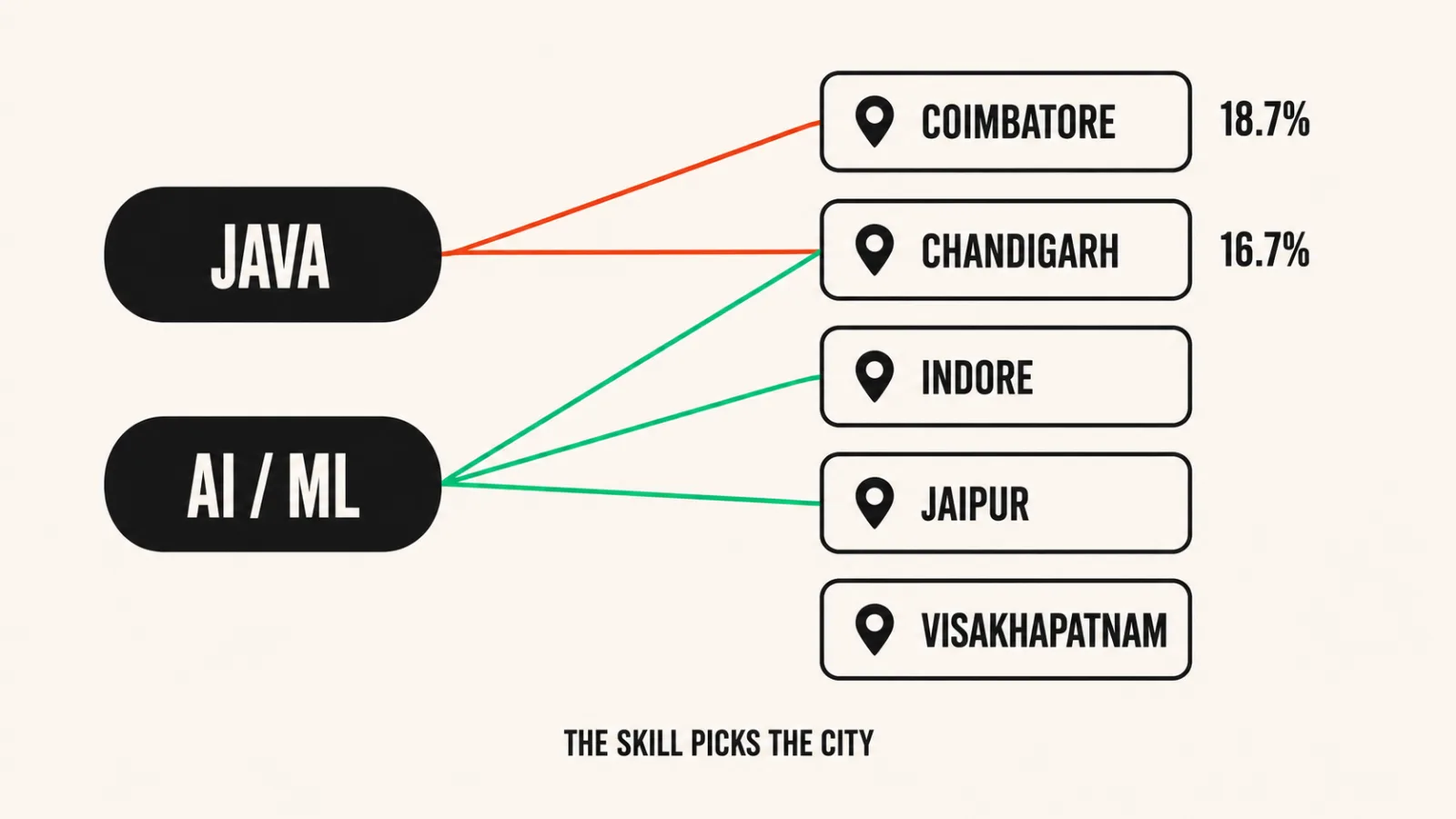
- Coimbatore shows the strongest single-city demand growth in the data at 18.7%, with notable demand for Java developers.
- Chandigarh follows at 16.7%, also with Java demand.
- Chandigarh, Jaipur and Indore lead AI and machine learning demand among tier-2 locations.
- Visakhapatnam, Coimbatore, Indore and Jaipur are all posting double-digit hiring growth.
The practical read: the skill matters as much as the city. A Java developer and an AI engineer should not be looking at the same shortlist, and generic "best tier-2 cities" listicles that rank places without naming roles are close to useless for an actual decision.
Why companies are moving, and why that is your salary
The stated reasons are consistent across every report: a 25% lower cost base, 20 to 30% lower attrition, and a growing STEM talent pool.
Sit with the first one. A 25% lower cost base is mostly payroll.
Companies are not opening in Coimbatore as a favour to Coimbatore. They are opening there because the same work costs less, and the largest component of what costs less is what they pay you. Any honest version of this advice has to say that out loud, and most of them do not.
That does not make it a bad move. Rent, commute and cost of living usually fall further than salary does, so real disposable income can improve. But it means the comparison to run is not "is the offer lower than a Bengaluru offer". It is:
- Offer, minus local cost of living, against metro offer minus metro cost of living.
- How many other employers in that city could hire you if this job ends. This is where the 7% figure bites.
- What the role does to your next move. A GCC role in a growing hub reads differently on a CV than a support function that happened to relocate.
The second point is the one people underweight. In a metro, losing your job is a search. In a city with a handful of employers for your skill, it can be a relocation.
What to actually do
Pick the city from your skill, not from a ranking. Java points at Coimbatore and Chandigarh. AI and ML point at Chandigarh, Jaipur and Indore. A list of "top tier-2 cities" with no role attached cannot answer your question.
Count the employers before you count the salary. Search openings in that city for your exact skill. Under ten is a concentration risk regardless of how good the offer is.
Ask whether the office is a GCC or a delivery annexe. GCCs are being built as capability centres with real scope. A cost-saving satellite is a different job with the same commute.
Negotiate against local cost, not against a metro number. Going in anchored to a Bengaluru figure usually ends the conversation. Going in with local rent, transport and living costs gives you an argument the employer can actually agree to.
If you are unplaced rather than choosing, widen the geography early. The wider 2026 hiring picture is that access is filtered rather than absent, and tier-2 postings often draw far fewer applicants per role than the same job in a metro.
Common mistakes
Quoting the 40% GCC surge without the base. It is 5% to 7% over six years. Ninety-three percent of GCCs are still elsewhere.
Comparing a tier-2 offer to a metro salary. The cost base is 25% lower by design. Compare disposable income after local costs, not headline numbers.
Ignoring employer concentration. Growth rate tells you about the future. The number of employers hiring your skill today tells you what happens if this role ends.
Treating tier-2 as one category. Coimbatore at 18.7% with Java demand and Jaipur with AI and ML demand are different job markets that share a label.
Moving before the offer is firm. Offer disruption is running high across Indian hiring this year, and it is considerably more expensive when you have already signed a lease.
Key takeaways
- Tier-2 tech hiring grew 25% against 10% in tier-1 metros, and the direction of travel is not in question.
- Tier-1 still holds 53% of planned hiring against tier-2's 32%, so the growth is fast on a smaller base.
- The widely quoted 40% surge in tier-2 GCC share is a move from 5% in 2019 to 7% in 2025. Around 93% of GCCs remain outside tier-2.
- Coimbatore leads single-city growth at 18.7% and Chandigarh follows at 16.7%, both with Java demand. Chandigarh, Jaipur and Indore lead tier-2 demand for AI and ML.
- Companies cite a 25% lower cost base and 20 to 30% lower attrition. The cost saving is largely payroll, which means yours.
- The right comparison is disposable income after local costs, not offer against metro offer.
- Count how many employers in that city hire your specific skill. Under ten is a concentration risk that a good offer does not cancel.
If you are on the other side of this and setting up a delivery base rather than looking for a role, the same concentration logic applies in reverse, and the processes worth automating early are the ones that would otherwise need headcount you cannot easily hire locally. For the platform side of a job search rather than the geography side, we went through where to actually apply.