
You have sent forty applications this month. You have heard back from two, one of which was a rejection template with your name spelled wrong.
The problem usually is not your resume. It is that you are applying on the wrong platform for the kind of job you want, alongside four thousand other people who found the same listing the same way.
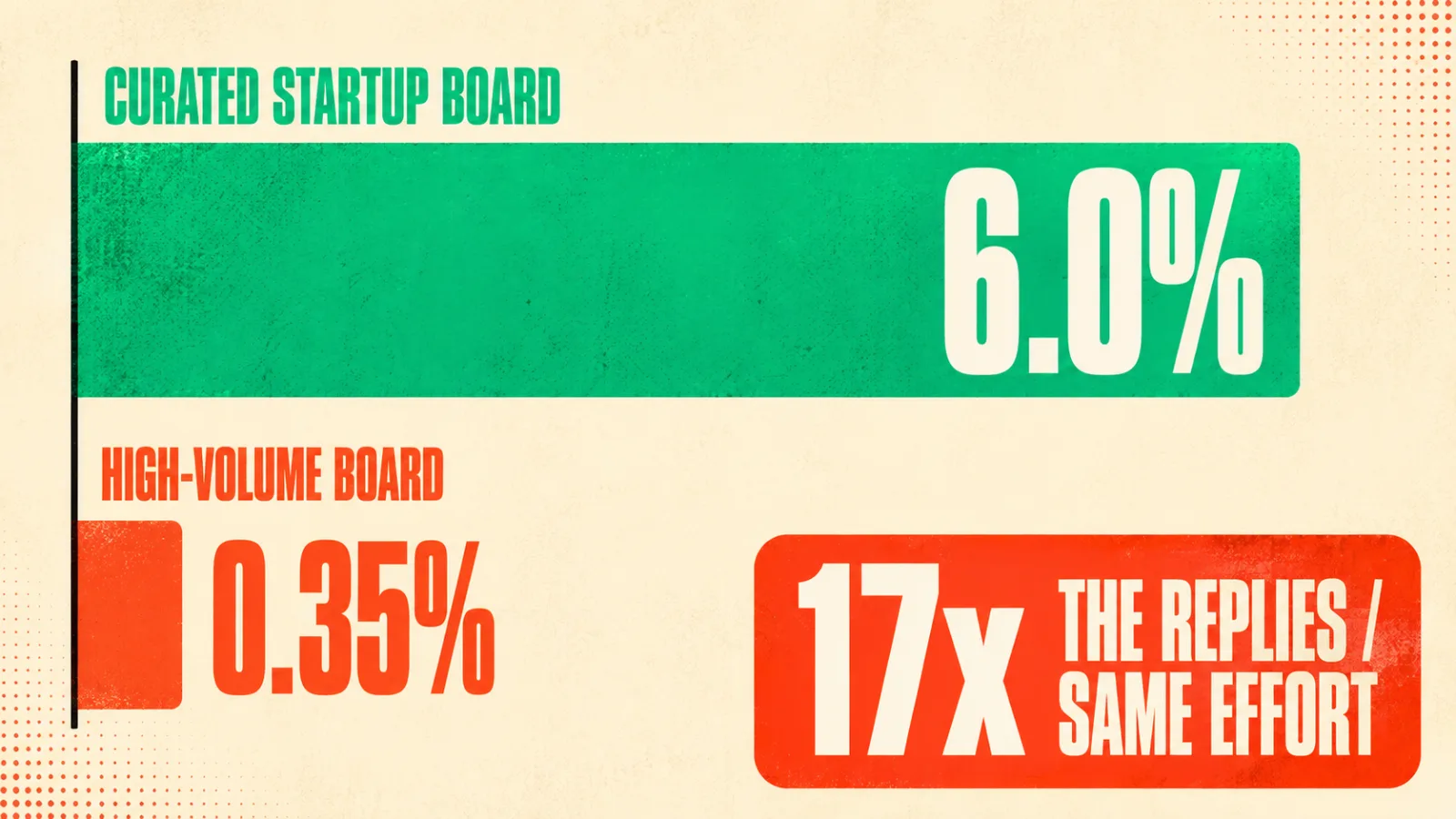
Different boards have wildly different odds. One study of application outcomes put the reply rate on a startup-focused board at 6.0% and on a large general tech board at 0.35%, a seventeen fold gap on the same effort. This is where the ten worth your time actually are, what each one is good at, and who should be on which.
What actually separates a good job board from a bad one
Three things: how many other people see the same listing, whether a human at the company reads applications from that source, and whether salary is shown before you spend an hour applying.
Volume is the enemy. A board with ten million listings sounds generous and behaves like a lottery, because the same posting is being blasted to everyone and the company is drowning. A curated board with two thousand listings can be better odds even though it looks smaller.
The second one matters more than people expect. On some platforms your application lands in an applicant tracking system nobody opens. On others it goes to the founder's inbox. Same effort, completely different outcome.
A board with ten million listings is not ten million chances. It is one lottery with ten million tickets already sold.
The ten platforms, and what each one is for
| Platform | Best for | Cost to apply | What it does well | Watch out for |
|---|---|---|---|---|
| Wellfound | Venture-backed startups, all levels | Free | Salary and equity shown up front, one-click apply, often reaches founders directly | Listing volume has thinned since its AngelList days, so pair it with something else |
| Y Combinator Work at a Startup | Early-stage, high-risk high-upside roles | Free | Every company is YC-backed, so quality is pre-filtered. One profile applies to many | Small companies mean small teams and little structure. Not for people who want mentoring |
| Everything, especially mid and senior corporate roles | Free | Nothing else has the reach, and referrals travel through it | Easy Apply is where applications go to die. Use it to find the role, then apply on the company site | |
| Welcome to the Jungle | Mid to senior roles at funded companies, Europe-heavy | Free | Absorbed Otta, so it kept the candidate-first curation and deep company profiles | Coverage is thinner outside Europe and the UK |
| Hacker News Who Is Hiring | Engineers who want to skip recruiters | Free | Posted by the person doing the hiring on the first working day of each month. Replies come from humans | No search, no filters, no structure. You read a giant thread |
| Built In | Tech roles tied to a specific city | Free | Organised by tech hub, with real company profiles rather than logos | Mostly United States. Limited use elsewhere |
| We Work Remotely | Remote-first roles | Free | Remote is the default, not a filter you tick and then get ignored | Popular listings attract thousands of applicants worldwide |
| Naukri | India, breadth across every experience level | Free | Still the largest pool in India by a distance, and recruiters genuinely search it | Volume-driven. Expect recruiter spam and keyword matching over fit |
| Instahyre | India, product and startup roles | Free | Companies approach you. Matching favours fit over keyword overlap | Smaller catalogue, weighted to Bangalore, Delhi NCR and Pune |
| Cutshort | India, skill-matched tech roles | Free | Skill-based matching plus direct chat with the recruiter, which removes the email lag | You have to keep the skill profile honest or the matching gets worse |
Every one of those is free for the person applying. Any board asking you for money to apply is selling you something else.
Which of these should you actually be on?
Pick two or three, not ten. Applying badly in ten places is worse than applying well in two, because a scattered profile is a worse profile everywhere.
You are a junior developer or a recent graduate. Naukri or LinkedIn for breadth, plus Y Combinator Work at a Startup for the long shots. Early-stage startups hire on demonstrated ability more than on years, so a good project can beat a degree there in a way it cannot at a large company.
You have three to eight years and you want out of services work. Instahyre and Cutshort. Both are built for exactly this move and both put you in front of product companies without a recruiter in between. Add Wellfound if you are open to equity-heavy offers.
You are senior and you want a role with real scope. Welcome to the Jungle and Hacker News Who Is Hiring. Senior roles are rarely won through a form. They are won by talking to the person who wrote the job description, and both of those get you closer to that person.
You want remote work with a company outside India. We Work Remotely and Wellfound. Be honest with yourself about timezone overlap, because that is the filter that actually decides these, not your resume.
You want a specific city. Built In if that city is in the United States, LinkedIn everywhere else.
You are changing fields, into AI or automation from something adjacent. Y Combinator Work at a Startup and Hacker News. Small teams care what you can build this month. Large ones care what your last job title was. That is the whole difference for a career switcher.
What to do once you have picked
Volume is not the lever. Everyone already tried volume. The lever is being specific.
-
Apply within 48 hours of the posting going up. Most roles collect the bulk of their applications in the first three days, and many are effectively decided before the listing comes down.
-
Write two sentences that could only be about that company. Not a cover letter. Two sentences that prove you looked at the product. This is the single cheapest thing that separates you from the pile.
-
Find the role on a board, apply on the company site. Aggregators lose applications and add a middle layer. The exception is the boards above where applying is the point, like Wellfound and Work at a Startup.
-
Put the work somewhere public. A repository, a live thing, a writeup. For anything AI or automation shaped this now matters more than the resume, because the field moves faster than credentials do.
-
Track what you sent and where. Twenty applications you can follow up on beat two hundred you cannot.
Two sentences that could only be about that company will do more than two hundred applications that could be about anyone.
Common mistakes
Treating LinkedIn Easy Apply as applying. It is a button that adds you to a count. Use LinkedIn to find the opening and the people, then apply where the company actually reads.
Ignoring the boards with fewer listings. Smaller often means curated, and curated means the company is paying attention. The instinct to go where the most jobs are is the instinct that produces forty applications and two replies.
Applying to a startup the way you apply to a large company. A formal, hedged, keyword-stuffed application reads as a bad fit at a nine-person company. They are looking for someone who will ship, and the application is your first sample of how you communicate.
Skipping salary-transparent boards because the number looks low. The number on a transparent board is real. The unlisted one at the company that will not say is not automatically higher, and you will find that out in week three of their process.
Only using the platforms in your own country. Remote hiring did not go away, it got pickier. If your timezone overlaps a European or American team by four hours you are in the running on boards most of your peers never open.
Key takeaways
- Reply rates differ by more than an order of magnitude between boards, so where you apply matters as much as what you send.
- Pick two or three platforms that match your situation and use them properly, instead of spreading thin across ten.
- Wellfound and Y Combinator Work at a Startup are the two highest-signal places for startup roles, and both are free.
- In India, Instahyre and Cutshort are the platforms built for moving into product companies. Naukri is for breadth.
- Hacker News Who Is Hiring has no search and no filters, and still gets engineers more human replies than most polished products.
- Apply within 48 hours, and include two sentences that could only be about that company.
- Use LinkedIn to find the role and the people, then apply on the company's own site.
If you are on the other side of this and trying to hire for AI or automation work rather than apply for it, the shape of the problem is usually not the job board. It is that the role has not been scoped tightly enough to describe. That is the part we help with in AI and automation projects. And if you are switching into this field, our comparison of the agent frameworks is a reasonable place to start on what teams actually run in production.