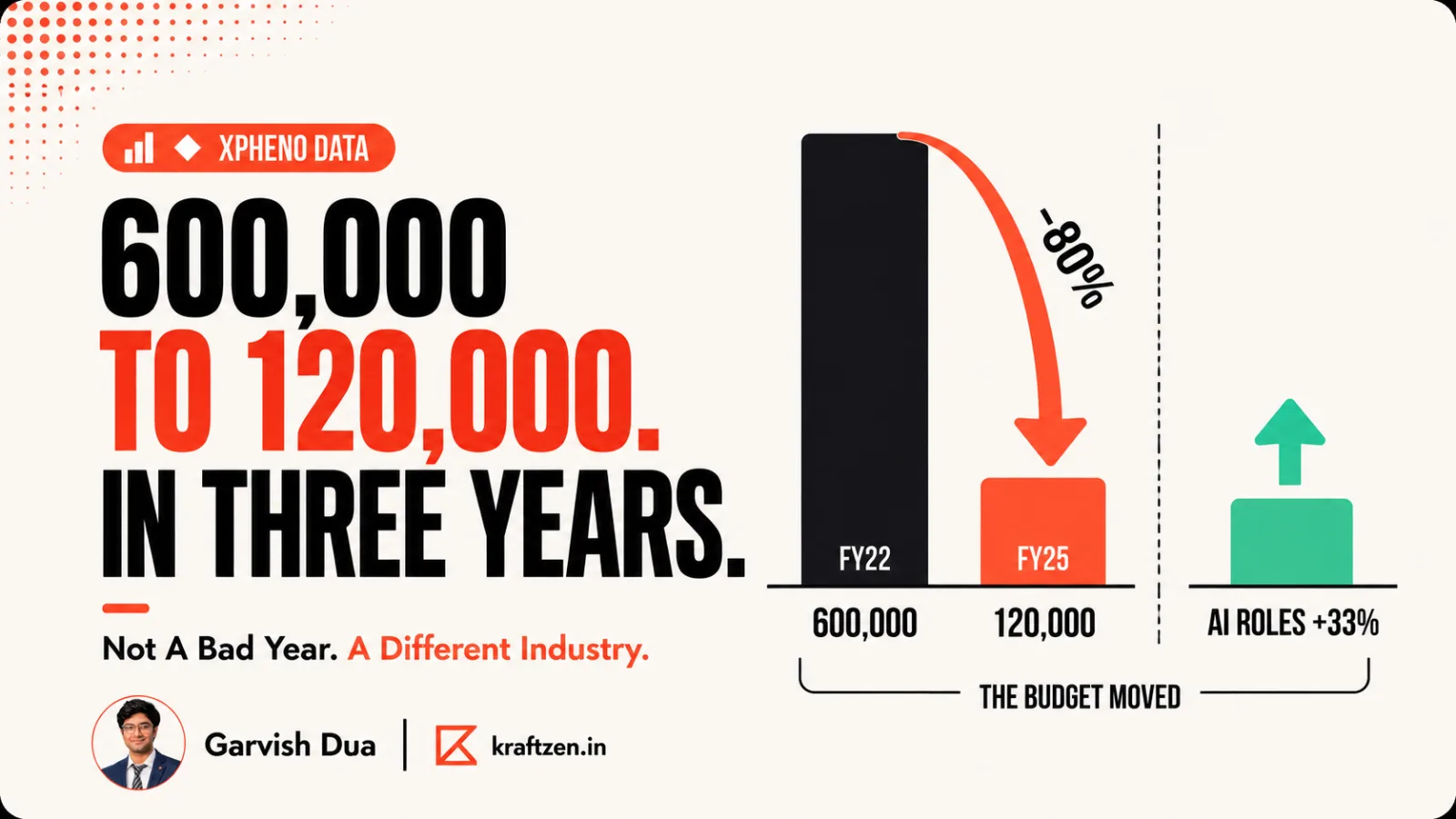
In FY22, India's IT services firms hired about 600,000 freshers.
In FY25, they hired about 120,000.
That is an 80% drop in three years, measured by the staffing firm Xpheno. TCS alone cut fresher hiring by 43%.
If you are graduating into this, the important word is not the number. It is structural. A slowdown reverses when the economy picks up. A structural change does not, because the thing that changed is how the work gets done.
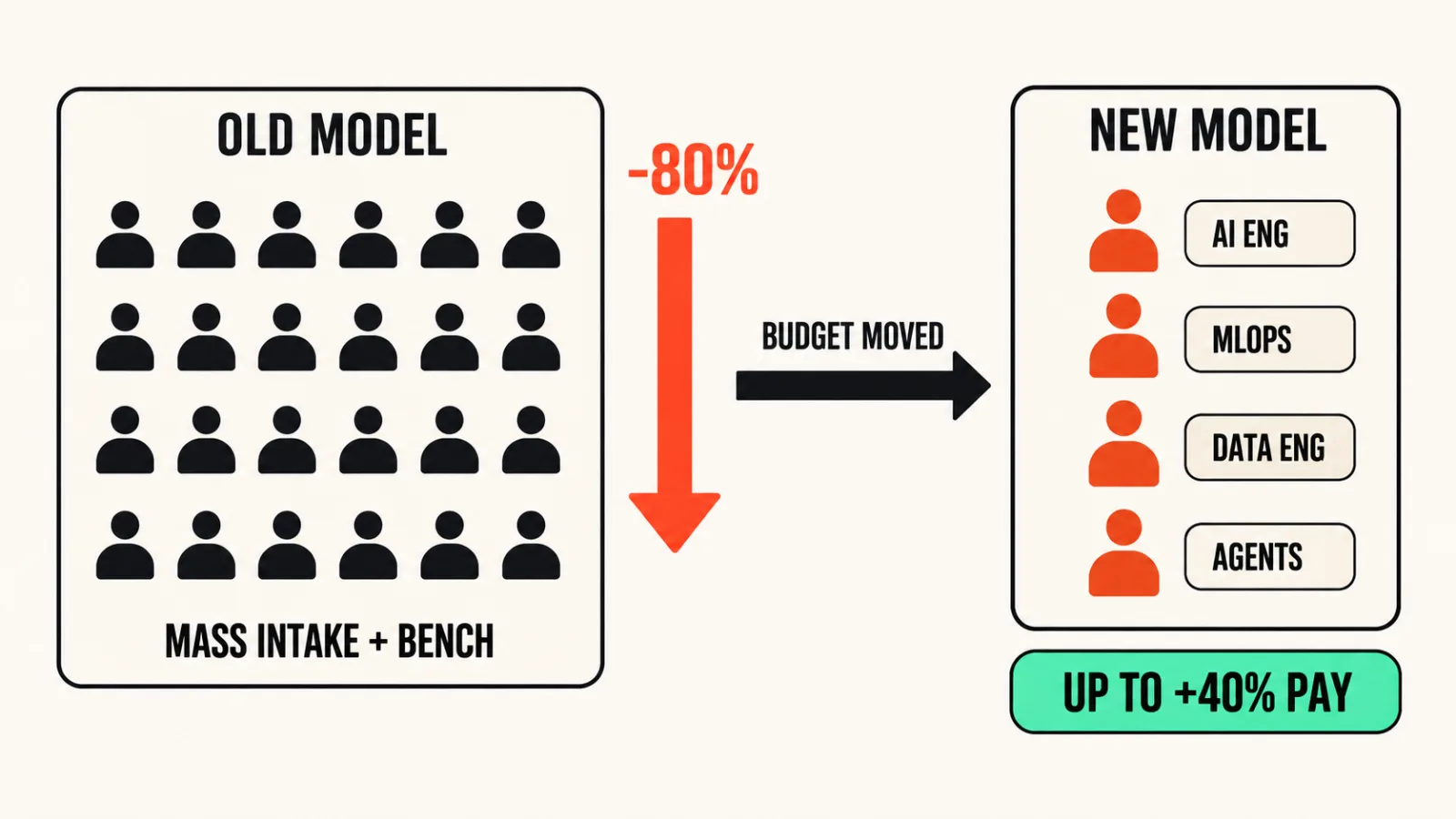
The money did not disappear. It moved. This post is about where it went, because that is the part you can actually act on.
The number, plainly
| Freshers hired by IT services | |
|---|---|
| FY22 | about 600,000 |
| FY25 | about 120,000 |
| Change | down roughly 80% |
Source: Xpheno. TCS cut its own fresher intake by 43%, and Wipro and Tech Mahindra have both trimmed FY26 guidance further. Hiring is expected to be only marginally higher this financial year.
Why "structural" is the word that matters
A slowdown and a structural change look identical from inside your final year. Both mean nobody is calling back. They demand completely different responses.
A slowdown is a pause. Demand dropped, it will return, and the sensible move is to wait it out and keep your preparation the same.
A structural change means the job itself changed. The old model worked like this: hire thousands of graduates, train them for months on a bench, and bill them out on large projects where the work was repetitive enough that a fresh graduate could learn it quickly.
AI took the repetitive layer. Not the whole job, just the part that made mass hiring economic. Once a team of four with good tooling does what took twelve, you do not need to hire twelve.
So the bench model is gone, and waiting for it to come back is waiting for something that is not coming.
A slowdown means wait. A structural change means prepare differently. Telling them apart is the only decision this data asks you to make.
Where the budget actually went
Here is the part almost no coverage includes, and it is the reason this post exists.
AI job postings jumped 33% in July, according to Info Edge. Xpheno's own tracker shows 57,000 active openings in IT services and 117,000 across the wider tech sector, plus 17,000 active GCC openings in August alone.
Those are not small numbers. The hiring did not stop. It got selective, and it moved toward people who can do something specific on day one.
What it moved toward:
| Role | Typical pay | Source |
|---|---|---|
| Senior AI Engineer (Hyderabad) | ₹25 to ₹40 lakh | Michael Page |
| AI Research Scientist | ₹25.1 lakh median | PayMetric Labs |
| MLOps Engineer | ₹22.7 lakh median | PayMetric Labs |
| Emerging tech roles generally | up to 40% base-pay premium | EY Future of Pay 2026 |
The named skills are consistent across every report: GenAI, AI engineering, MLOps, agents, machine learning, data engineering and RAG.
Read that list carefully, because it is mostly engineering, not research. MLOps and data engineering are about getting things to run reliably in production. That is a craft you can learn without a PhD, and it is where a large share of the openings sit.
Where the openings are
Hiring growth is uneven by city, and the metros people default to are not the fastest growing.
- Kolkata: +17% year on year
- Hyderabad: +16%
- Chennai: +11%
- Bengaluru: +8%
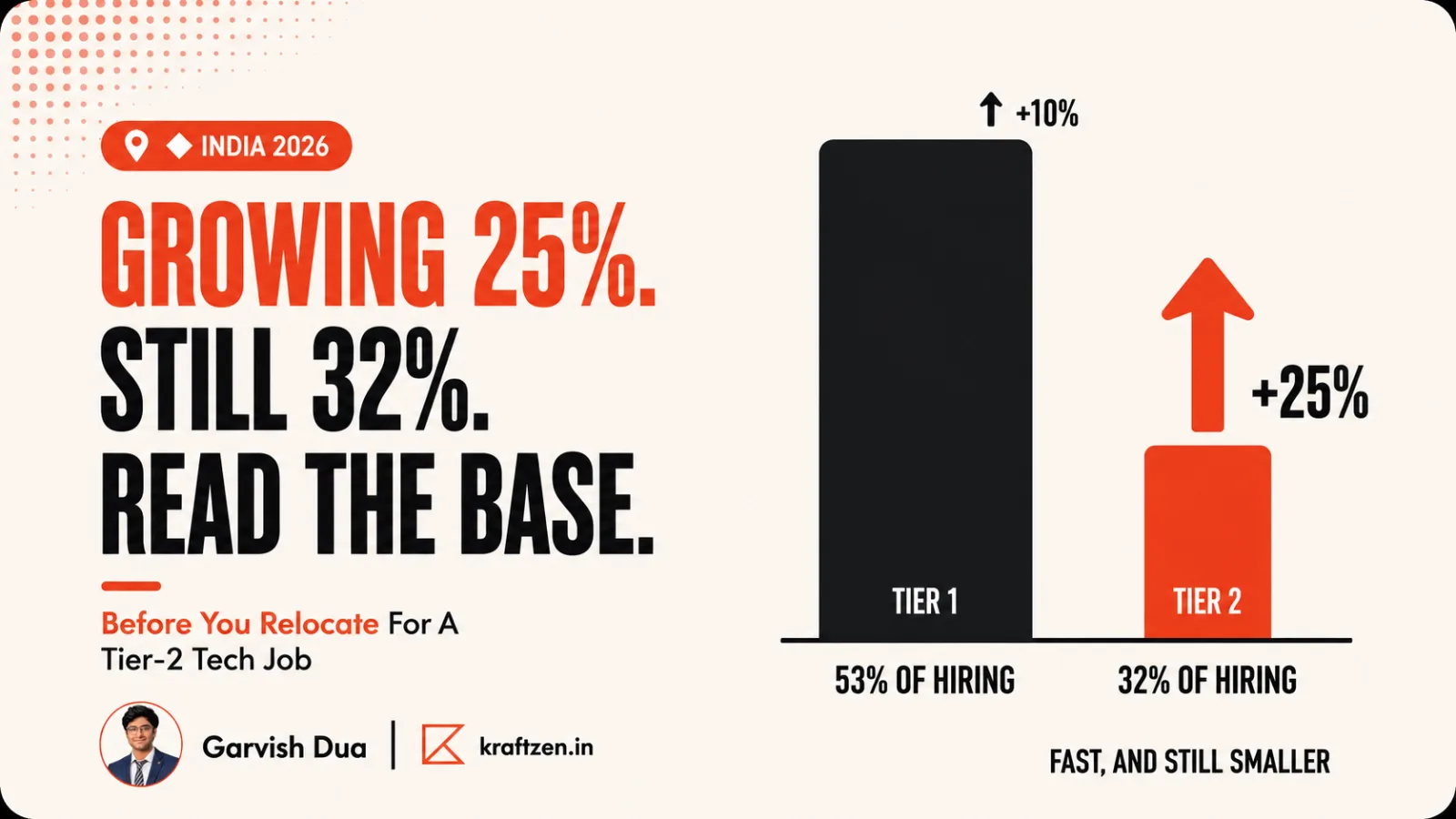
Bengaluru is still the biggest market by volume, and it is growing at half Hyderabad's rate. If you are choosing where to concentrate a search, growth rate and competition matter alongside size. We went through the tier-2 version of this question separately, including the trap of reading a growth percentage without reading the base underneath it.
What to actually do
Stop preparing for the bench. Months of general training after joining is what the old model paid for. Companies hiring now expect you to arrive useful. That is harder, and it is also a clearer target.
Pick one thing from the list and go deep enough to show it. GenAI, AI engineering, MLOps, agents, data engineering, RAG. One of these, built into something real that runs, beats a certificate in four of them.
Bias toward the engineering end. MLOps and data engineering are operational skills: deployment, monitoring, pipelines, making things not break. They need less theory than research roles and they carry a large share of the openings.
Build one thing that runs in production and stays running. Not a notebook. Something deployed, with a URL, that keeps working when you are not watching. The single most useful sentence in an interview right now is a specific account of what broke and how you fixed it.
Apply where the specialist openings actually are. 57,000 in IT services, 117,000 across tech, 17,000 in GCCs. These exist, and they are not filled through the same campus process that used to hire 600,000.
Do not wait for the old model. This is the whole point of the word structural.
Common mistakes
Reading it as a bad year. Three consecutive years of decline with FY26 guidance trimmed further is a trend, not a dip. Xpheno and the firms themselves describe it as structural.
Assuming there is no hiring. There are 117,000 active tech openings. The mass-intake route closed, the specialist route did not.
Chasing AI research roles specifically. The demand list is heavier on engineering than research. MLOps at ₹22.7 lakh median is a realistic target from an undergraduate degree in a way an AI Research Scientist role often is not.
Learning six tools shallowly. The pay premium goes to people who can be trusted with a system, which is demonstrated by depth in one area rather than breadth across many.
Defaulting to Bengaluru. It is growing at 8% while Hyderabad grows at 16% and Kolkata at 17%, with a fraction of the competition per opening.
Key takeaways
- IT services fresher hiring fell from about 600,000 in FY22 to about 120,000 in FY25, roughly 80%, per Xpheno. TCS cut its own intake 43%.
- The change is structural rather than cyclical. AI absorbed the repetitive layer that made mass hiring economic, so the bench model is not returning.
- Hiring did not stop. There are about 57,000 active openings in IT services, 117,000 across tech, and 17,000 in GCCs.
- AI job postings rose 33% in July per Info Edge, and emerging tech roles carry up to a 40% base-pay premium per EY.
- MLOps sits at a ₹22.7 lakh median and AI Research Scientist at ₹25.1 lakh. Senior AI Engineer roles in Hyderabad run ₹25 to ₹40 lakh.
- The named skills are GenAI, AI engineering, MLOps, agents, machine learning, data engineering and RAG. Most of that list is engineering, not research.
- Hiring growth by city: Kolkata 17%, Hyderabad 16%, Chennai 11%, Bengaluru 8%.
- Build one thing that runs in production rather than several that do not. Companies hiring now expect you useful on arrival.
If you want the wider picture of why applications disappear even when companies are hiring, we covered the filters that sit between the two, and where to actually send applications goes through the platforms one by one.