Companies are hiring. You are not getting hired.
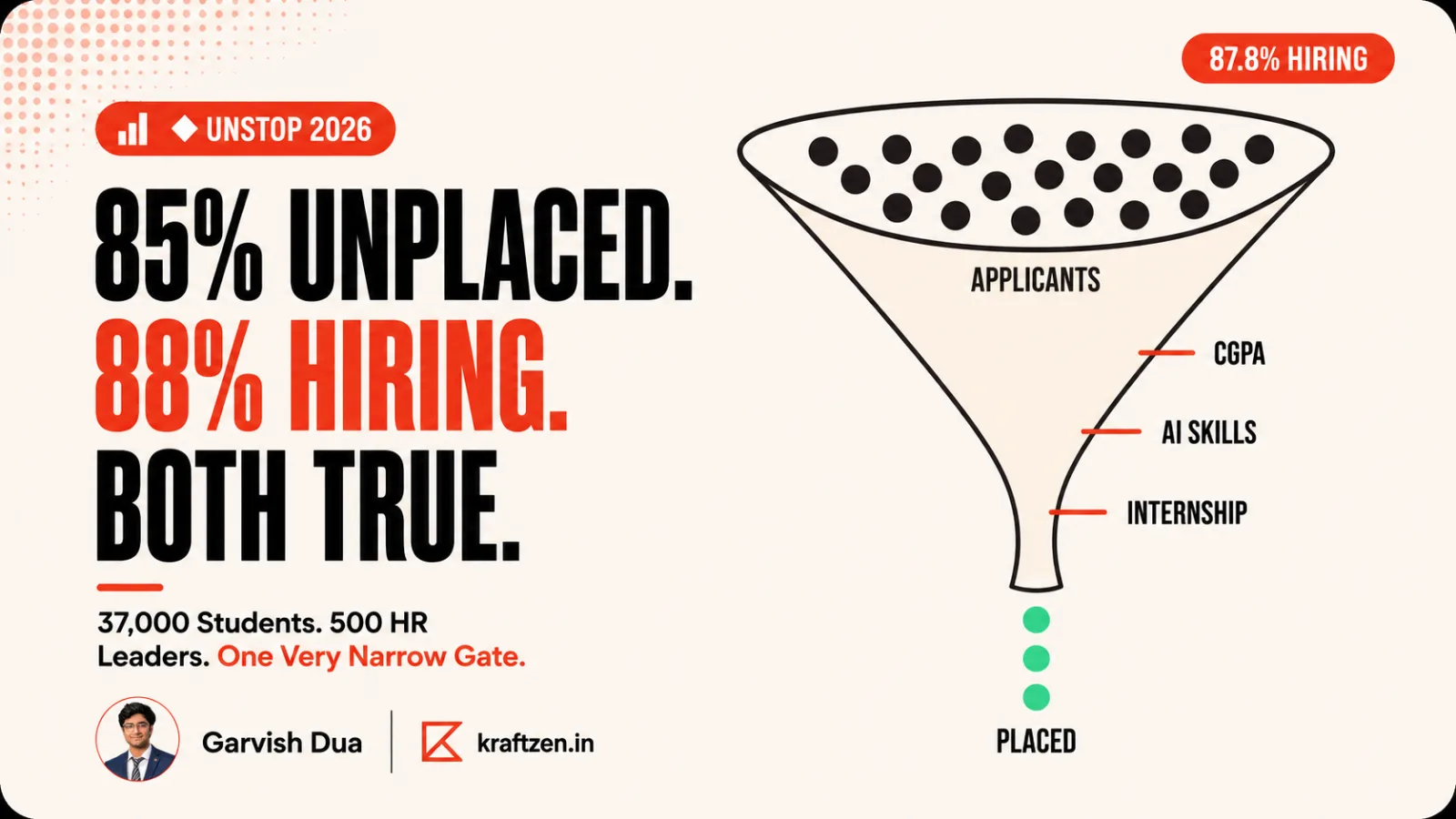
Both of those are true at the same time, and they come from the same survey. Unstop asked 37,000 students and 500 HR leaders between January and February 2026. 87.8% of companies said they were actively recruiting. 85% of engineering students were still unplaced.
The usual reading is that one side is lying. The employers are not really hiring, or the students are not really trying.
Neither is what the data says. Hiring in 2026 is selective rather than stalled, and the filters have moved somewhere most placement advice never looks. Here is where.
The two numbers, side by side
| What was measured | Figure |
|---|---|
| Companies actively recruiting on campus | 87.8% |
| Companies maintaining or increasing hiring budgets | 90% |
| Engineering students still unplaced | 85% |
| Undergraduate students still unplaced | 84% |
| MBA students still unplaced | 74% |
| Undergraduates who faced a delayed or rescinded offer | 17% |
That last row is the one nobody quotes, and it is the most useful. Seventeen percent of undergraduates did not fail to get an offer. They got one, and then it moved or vanished. Undergraduates were the worst affected group of all.
So "unplaced" is not one condition. It contains people who never got an interview and people who signed something that later evaporated, and those two need completely different responses.
Selective, not stalled
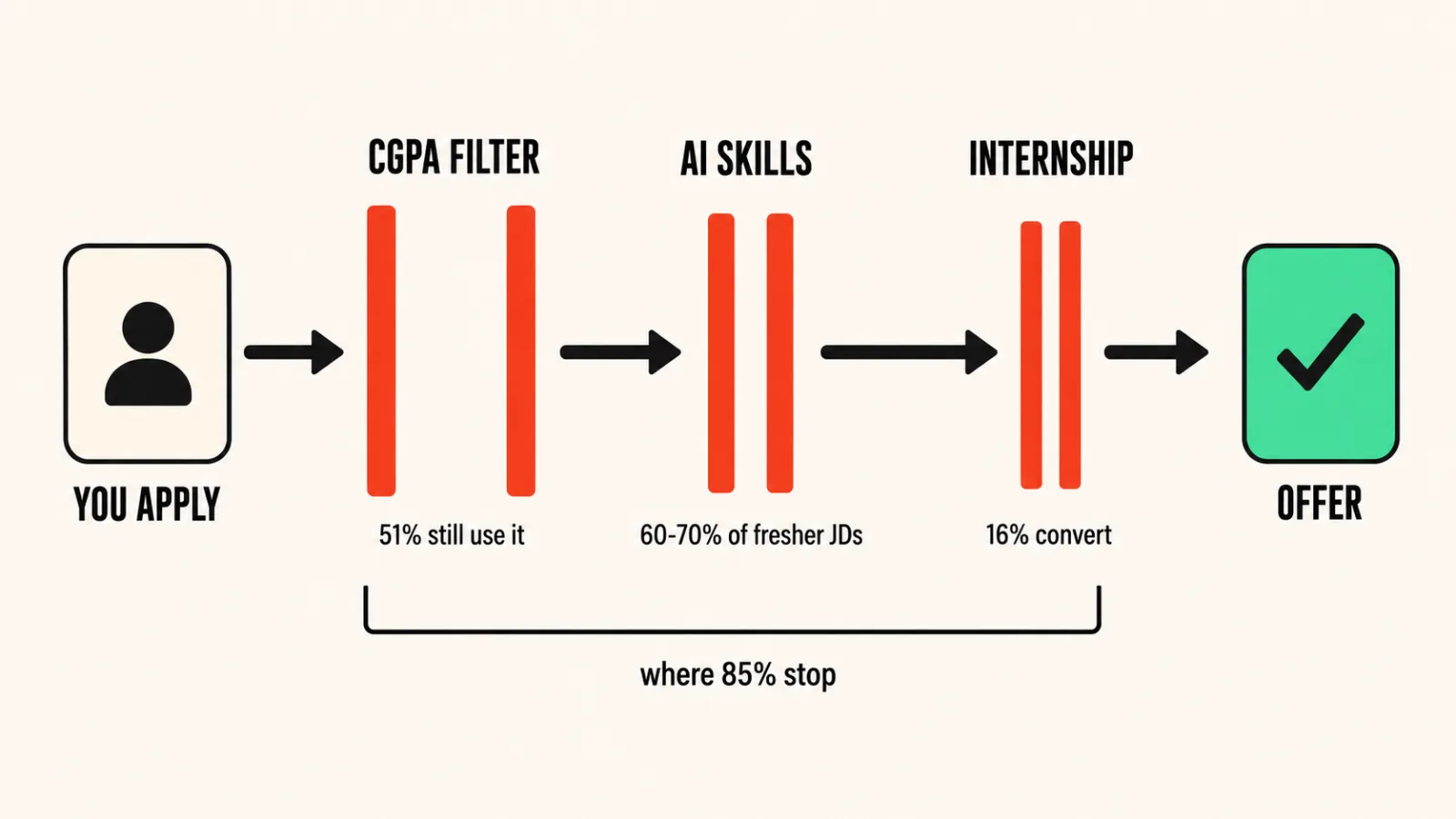
The report's own framing is that jobs exist but access is filtered and uneven. Three filters do most of the work.
CGPA is still deciding things, whatever the job ad says. Only 21% of organisations have fully moved to skills-first hiring. 42% describe themselves as in transition, which in practice means some roles and some rounds. 51% still let CGPA influence decisions. Every "we hire for skills, not marks" post you have read is describing one fifth of the market.
There is a striking number attached to this: dropping strict CGPA filters expands the qualified candidate pool by 40 to 50%. Half the people who could do the job are removed before anyone reads a line of their work.
AI is now assumed, including where it makes no sense. Between 60 and 70% of fresher job descriptions require AI or ML skills, and that includes non-technical roles. Whether every one of those roles genuinely needs it is a fair question, but it does not change what you are screened against.
Internships are a gate that mostly does not open. 78% of organisations run internship programmes. Only 16% convert more than 80% of their interns into full-time roles. An internship is worth having, and it is not the offer pipeline it is sold as.
Half the people who could do the job are removed before anyone reads a line of their work. That is what a CGPA filter does.
The expectation gap is real, and it is smaller than it looks
73% of undergraduate freshers expect a starting salary above ₹5 LPA. 40% get it.
The easy conclusion is that students are unrealistic. Be careful with that one, because the same survey says 90% would accept lower compensation for better learning and growth, and average campus salaries rose 3.91%, which is below inflation.
So students are not holding out for money. Most say they would trade it. The 33 point gap is a forecasting error, not a stubbornness problem, and the fix is knowing the real band for your specific role and city before you turn anything down.
What this changes about how you apply
Stop optimising the part that is already fine. If 87.8% of companies are hiring, the market is not your problem. Your position in a filtered queue is.
Find out whether your target companies actually dropped CGPA. Not from their careers page, which says what it is supposed to say. From people a year or two ahead of you who interviewed there. Half of employers still use it, so this is a real question with a real answer, and it decides whether your effort goes into marks or into work you can show.
Treat the AI requirement as a filter to clear, not a career to switch into. If two thirds of fresher listings mention it, a shallow but genuine familiarity clears more gates than deep expertise in one framework. Build one small thing end to end and be able to talk about what broke.
Apply off campus, seriously rather than as a backup. 95% of students say they are open to off-campus roles, which means everyone says it, and far fewer build a real pipeline. We wrote a separate post on where to actually apply, platform by platform, because "apply off campus" is advice that stops exactly where it gets useful.
If your offer was delayed rather than denied, you are in a different situation. You are in the 17%, you have more room to negotiate than a fresh applicant does, and you should keep interviewing rather than waiting politely. A deferred joining date is not a signed start date.
Common mistakes
Reading "companies are hiring" as good news for you personally. It is a statement about employer intent, not about your odds. Both numbers in the headline are true and only one of them is about you.
Believing the skills-first messaging at face value. One in five companies has actually made the change. Four in five have not, or only partly. Plan for the market that exists.
Treating an internship as a job offer with a delay. Only 16% of organisations convert most of their interns. Do the internship, and keep applying the entire time.
Chasing the AI requirement into a specialisation you do not want. The listings ask for familiarity far more often than depth. One project you understand completely beats three tutorials you followed.
Waiting quietly on a deferred offer. Seventeen percent of undergraduates had an offer delayed or withdrawn. Politeness is not a strategy, and the company deferring you is still interviewing other people.
Key takeaways
- Both headline numbers are from the same Jan to Feb 2026 survey of 37,000 students and 500 HR leaders. 87.8% of companies were hiring and 85% of engineering students were unplaced.
- Hiring is selective rather than stalled. Access is filtered, and the filters are CGPA, AI skills and internship conversion.
- Only 21% of employers have fully moved to skills-first hiring, and 51% still let CGPA influence decisions.
- Removing strict CGPA filters expands the qualified pool by 40 to 50%, so the filter removes about half of the people who could do the job.
- 60 to 70% of fresher job descriptions require AI or ML skills, including non-technical roles.
- 78% of organisations run internships but only 16% convert more than 80% of interns, so an internship is a foot in the door and not a pipeline.
- 73% of undergraduates expect over ₹5 LPA and 40% get it, though 90% say they would take less for better learning. That is a forecasting gap, not a greed problem.
- 17% of undergraduates had an offer delayed or rescinded, the highest of any group. If that is you, keep interviewing.
If you are on the hiring side of this and the filters above are costing you candidates you would have wanted, that is a process problem before it is a tooling one, and automating the parts that should not need a person is a fair place to start once the process itself is right.