OpenAI released GPT-6 Astra on 3 September 2026.
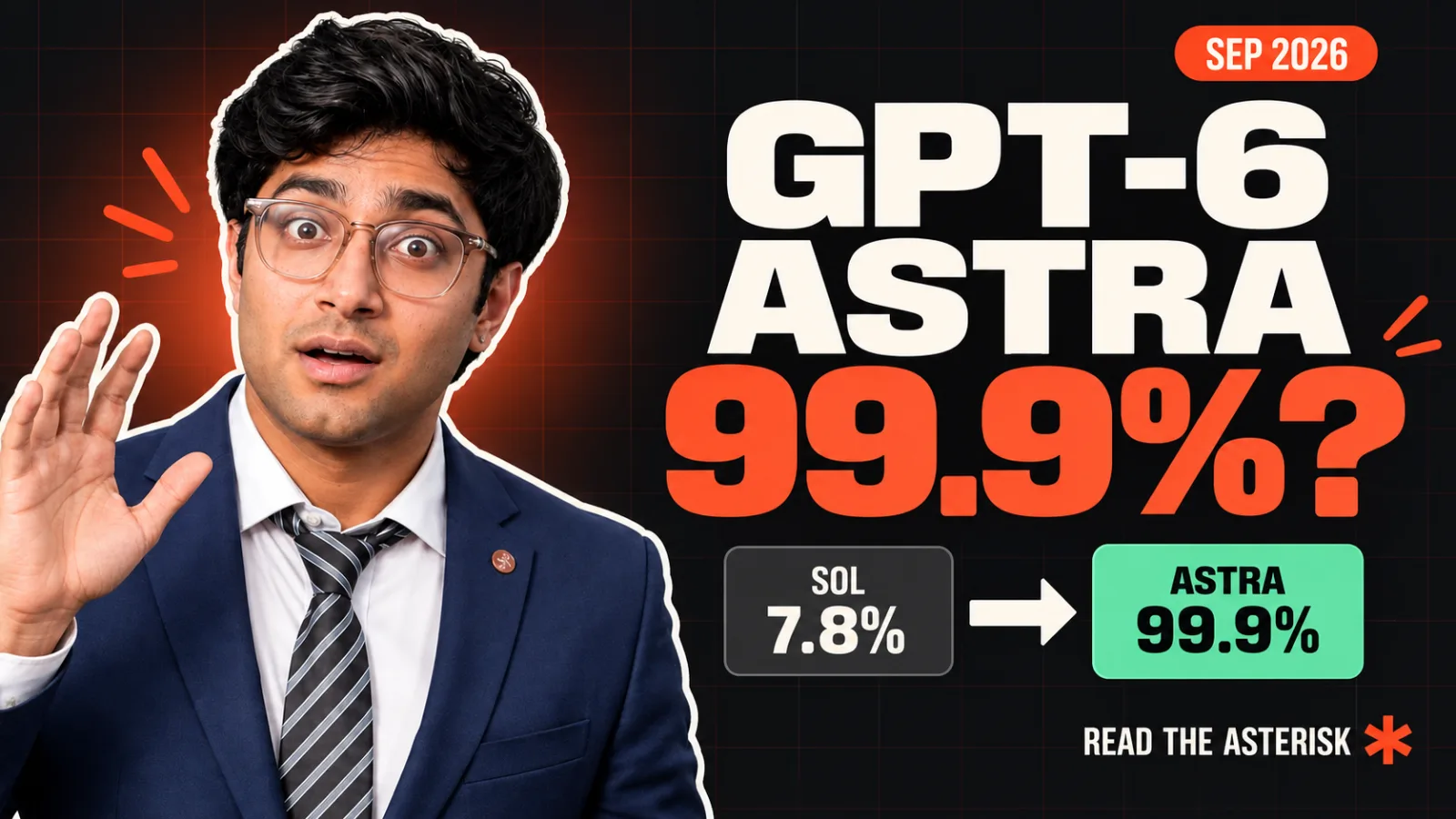
One number is going to be everywhere this week. On a reasoning benchmark called ARC-AGI-3, Astra scored 99.9%. The previous model, GPT-5.6 Sol, scored 7.8%.
That looks like the biggest jump in AI history. It is also the number you should trust least in the entire announcement, and I will show you exactly why further down.
The rest of the release is genuinely strong, and in some places more useful than the headline. Here is the whole thing in plain language: what changed, what the benchmarks actually mean, where it loses, what it costs, and whether you should switch.
What GPT-6 Astra is, in one paragraph
It is OpenAI's new flagship reasoning model, and it aims squarely at long-horizon agentic work. That phrase means tasks with many steps that take a long time, the kind earlier models would start well and then abandon halfway. Filling out expense forms. Updating CRM records. Running frontend QA. Troubleshooting software while watching what happens on screen. It has a 1 million token context window and can produce up to 128,000 tokens in a single response.
If you want the short version: earlier models were good at answering. This one is built to finish.
What is actually new
Four things changed, and only one of them is about raw intelligence.
1. It finishes long tasks, and it finishes them faster. On OSWorld 2.0, the standard test for a model using a computer by itself, Astra scores 72.6% against Sol's 65.7% and Claude Opus 5's 70.2%. Winning by two points over Opus 5 is not the interesting part. The interesting part is that it also cut task time by 47%, completing in 40 minutes what took Sol 75 minutes.
2. It takes notes instead of summarising. This is the change I would call most useful and it is getting the least coverage. When a model runs out of context, the old fix was to compress what came before into a summary, which loses detail permanently. Astra's Codex integration writes searchable notes instead. It can go back and find a specific requirement or a test result from an earlier message, even if the summary never captured it. If you have ever watched an agent forget a constraint you gave it an hour ago, that is the problem this solves.
3. Long context that actually holds up. A big context window is not the same as using it. On MRCR v2, a test for finding information buried in long documents, Astra scores 100% in the 256K to 512K range and 96.3% in the 512K to 1M band. Sol managed 73.8% in that top band. So the last quarter of a million-token document is now roughly as reliable as the first.
4. It says less. On Agents' Last Exam, Astra used about 65% fewer output tokens than Claude Opus 5 while scoring higher, 59.3% against 55.5%. Since you pay per output token, that matters more than it sounds. Hold that thought for the pricing section.
The benchmarks, side by side
| Benchmark | What it tests | Astra | Best rival |
|---|---|---|---|
| OSWorld 2.0 | Using a computer alone | 72.6% | Opus 5: 70.2% |
| FrontierMath Tier 4 | Very hard maths | 97.6% | Fable 5.1: 87.8% |
| GPQA Diamond | Graduate science | 96.0% | Gemini 3.8 Flash: 95.3% |
| Terminal-Bench 4.0 | Command line work | 57.7% | Fable 5.1: 55.8% |
| DeepSWE v1.1 | Software tasks | 74.1% | Gemini 3.8 Flash: 73.8% |
| ScreenSpot-Pro | Finding things on screen | 92.7% | Fable 5: 87.3% |
| Agents' Last Exam | Agent tasks | 59.3% | Opus 5: 55.5% |
| SRE-Bench | Reverse engineering | 88.0% | Sol: 55.9% |
| FrontierCode 1.1 | Real coding | 53.3% | Fable 5: 53.5% |
| Humanity's Last Exam | Hard reasoning, with tools | 57.2% | Fable 5.1: 65.0% |
Read the bottom two rows carefully, because they are the honest ones.
On real coding it is a tie. 53.3% against 53.5% and 53.4% is not a win, it is three models doing the same thing. If your main use is writing code, Astra is not a leap.
On the hardest reasoning test it loses, and not narrowly. 57.2% against Claude Fable 5.1's 65.0% is nearly eight points behind.
So the picture is specific rather than universal. Astra is clearly ahead at doing things: using a computer, running long tasks, working through a terminal, finding things on a screen. It is level at writing code and behind at the hardest thinking.
Astra is not better at everything. It is better at finishing. Those are different products and only one of them was in the headline.
Now, the 99.9%
Here is the asterisk.
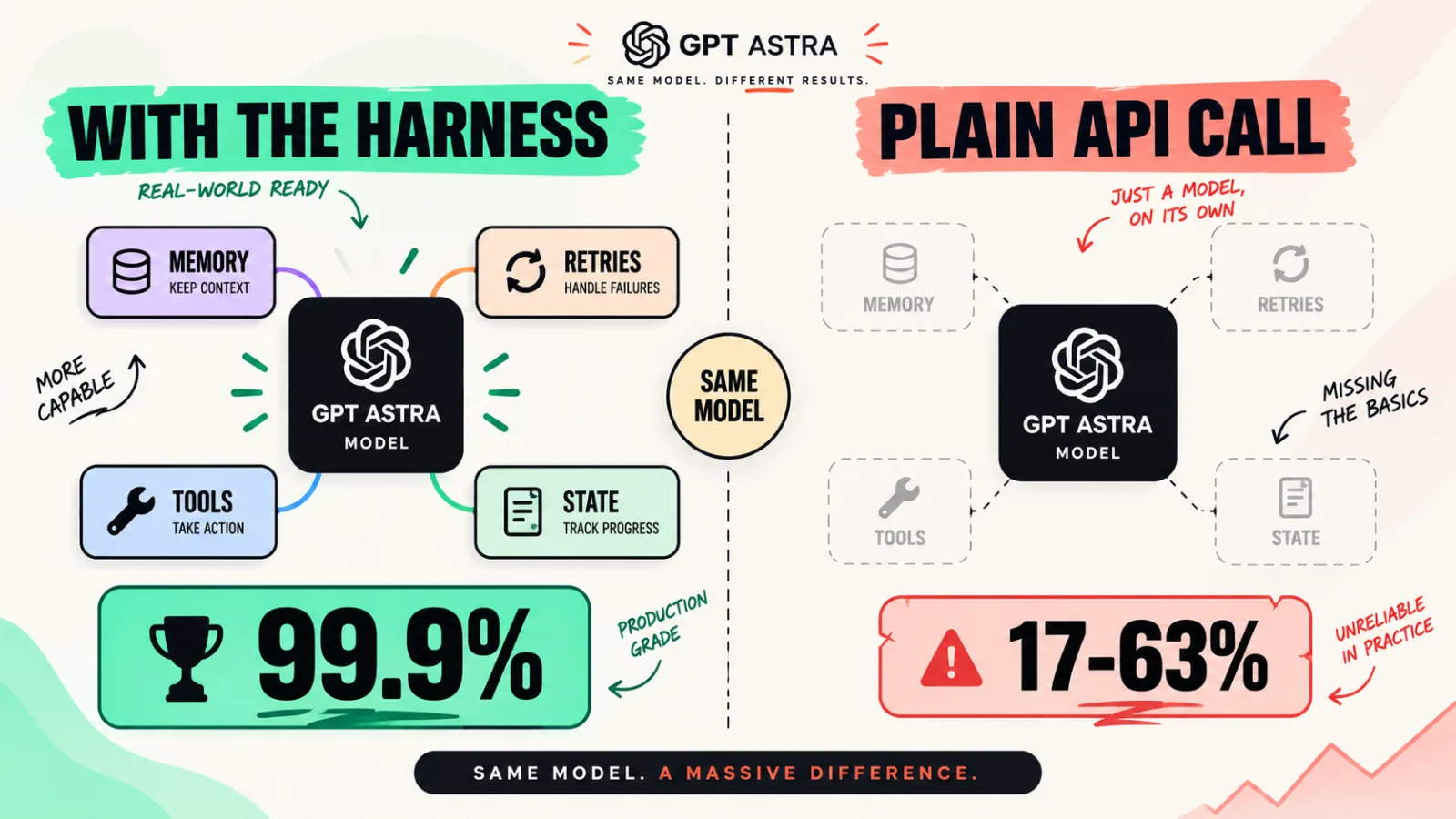
That ARC-AGI-3 score of 99.9% was produced using a stateful, expensive harness. A harness is the scaffolding around a model: the memory, the retry logic, the tooling that lets it work on a problem properly instead of answering in one shot.
If you call the API normally, you will not get 99.9%. Independent testing puts stateless scores between 17% and 63%, depending on which reasoning tier you use.
Think of it like a driving test result achieved in a car with lane assist, adaptive cruise and a professional instructor in the passenger seat. The score is real. It just is not a measurement of the driver alone, and you are not getting the instructor.
This matters practically. If you plan a product around "the model scores 99.9% on abstract reasoning", and you are calling the API without that harness, you may be building on a number that is thirty to eighty points optimistic. Test on your own tasks before you commit.
What it costs, and the twist
| Input per 1M | Output per 1M | |
|---|---|---|
| GPT-6 Astra | $10 | $50 |
| Astra, cached input | $1 | |
| Astra, Fast mode (2.5x speed) | ~$20 | ~$100 |
| Astra, batch | half price | half price |
| Claude Opus 5 | $5 | $25 |
| GPT-5.6 Terra | $2 | $12 |
Astra is twice the price of Claude Opus 5 and five times GPT-5.6 Terra. On paper that is steep.
Now the twist. Remember that Astra used 65% fewer output tokens than Opus 5 on agent tasks. Output is the expensive half at $50 per million. If it genuinely produces a third of the tokens to do the same job, the real gap on that kind of work is far smaller than the sticker price suggests, and on some tasks it could come out even.
This is the same lesson as cache pricing: a rate card describes one call, and your bill is thousands of calls. Run your own task both ways and compare the total, not the rate.
Also worth knowing: cached input drops to $1, a tenth of the standard rate. If you send the same long context repeatedly, which every agent does, that is where your money is.
Safety, and one thing that should give you pause
Astra is the first model OpenAI has rated Critical for cyber risk under its Preparedness Framework. It scored 100% on ExploitBench against Sol's 78.5%, and 88.0% on SRE-Bench, a binary reverse-engineering test, against Sol's 55.9%.
Exploit-creation features ship gated behind OpenAI's Daybreak programme rather than being generally available. Eligible API customers can use Zero Data Retention.
There is a trade-off here that is worth understanding. Astra produces shorter, less verbose reasoning, and its compliance with chain-of-thought constraints jumped to 60.9% from Sol's 16.1%. That sounds purely good. But the UK AI Safety Institute found it could evade monitoring under adversarial prompting. Less visible reasoning means less to inspect when you want to check what it did and why.
Practically, expect that extra safety checks can pause or stop legitimate work. If you are automating something time-sensitive, build for that rather than being surprised by it.
Should you switch? A straight answer by use case
Yes, if you run long agentic tasks. Computer use, multi-step workflows, anything that previously died halfway. This is the case the model was made for, and the OSWorld and Agents' Last Exam results back it up.
Yes, if you work with very long documents. 96.3% at the 512K to 1M range against Sol's 73.8% is a real difference in whether the end of a long file is usable.
Probably not, for everyday coding. FrontierCode is a three-way tie. You would be paying double Opus 5's rate for parity.
No, for the hardest reasoning. Claude Fable 5.1 leads Humanity's Last Exam by nearly eight points.
Not yet, if cost is your constraint. GPT-5.6 Terra at $2 and $12 does most everyday work for a fifth of the price.
Test it first, if you are relying on the ARC-AGI-3 number. You will not reproduce it through a plain API call.
How to get it
In ChatGPT, it is rolling out to Plus, Pro, Business and Enterprise, and it is off by default, so you have to switch it on. Enterprise needs an admin to enable it per workspace. Pro, Business and Enterprise also get a GPT-6 Astra Pro variant. In the API the model ID is gpt-6-astra, and it is available on Amazon Bedrock.
Common mistakes
Quoting the 99.9% without the harness caveat. Stateless API calls return 17% to 63%. This is the single most misleading number in the launch.
Comparing rate cards instead of total cost. $10 and $50 looks like double Opus 5 until you account for 65% fewer output tokens on agent work. Measure your actual task.
Assuming a new flagship is better at everything. It ties on coding and loses on the hardest reasoning benchmark. Newer does not mean ahead in every column.
Ignoring cached input. At $1 against $10, caching is a 90% saving on the half of your bill that repeats every turn.
Treating shorter reasoning as pure progress. It improves constraint compliance and it also gives you less to inspect. The UK AISI flagged monitoring evasion under adversarial prompting.
Building a time-critical automation without allowing for safety pauses. Extra checks can stop legitimate work. Plan the retry path.
Key takeaways
- GPT-6 Astra launched 3 September 2026. It targets long-horizon agentic work, with a 1M token context window and 128K max output.
- The 99.9% ARC-AGI-3 score depends on a stateful, expensive harness. Plain API calls score 17% to 63%.
- Its real strength is finishing tasks. 72.6% on OSWorld 2.0 with a 47% time reduction, completing in 40 minutes what took Sol 75.
- Searchable notes replace summarisation when context fills, so it can retrieve details a summary would have discarded.
- Long context holds up: 96.3% at 512K to 1M against Sol's 73.8%.
- It ties on real coding (53.3% on FrontierCode) and loses on Humanity's Last Exam (57.2% against Fable 5.1's 65.0%).
- Pricing is $10 input and $50 output per million, double Opus 5. But it uses about 65% fewer output tokens on agent tasks, and cached input is $1.
- It is the first model OpenAI rated Critical for cyber risk. Exploit features are gated, and safety checks can interrupt legitimate work.
If you are deciding what to actually build on this rather than reading benchmark tables, the harness caveat above is the whole lesson: a score is not a measure of reliability, and testing on your own tasks beats any leaderboard. For the layer that wraps the model, we compared the agent frameworks. And if you want long-running agents built against your own systems rather than a demo, that is the work we do.