Reported star counts for DeepSeek Harness, from four sources covering the same repository: 33,000 within hours. 64,000. 95,000 in two days. 165,000 in eleven days.
Those cannot all be true, and the spread tells you what most of the coverage is worth. It launched on 13 August 2026 and nearly everything written since has been a launch recap.
So set the number aside. There are two things about dsh that are genuinely worth an engineer's attention, and neither is how fast it got starred.
What "everything is a plugin" actually means
Most agent frameworks let you plug in tools. That is table stakes and has been for two years.
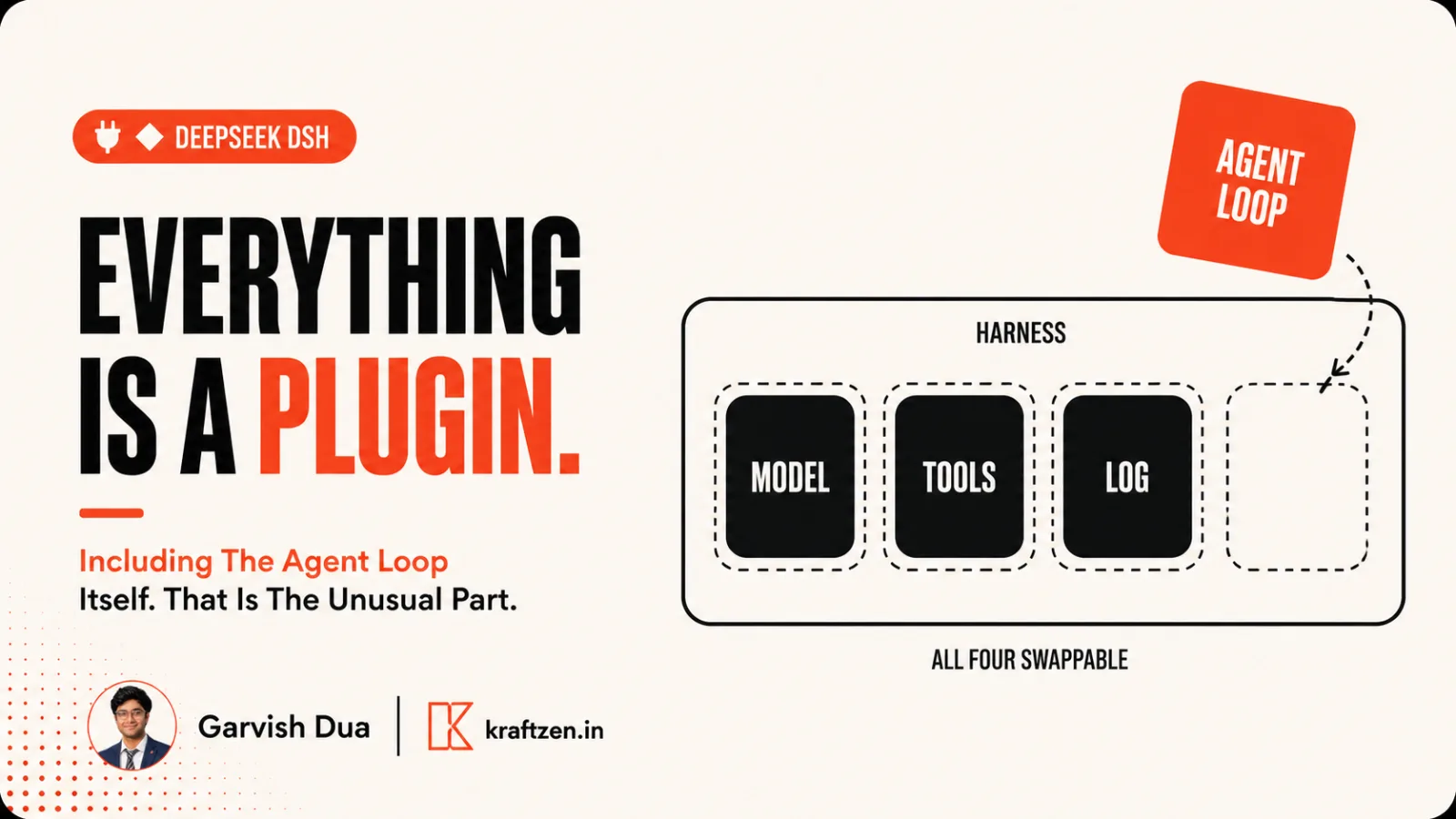
dsh is MIT licensed, written in TypeScript, and built on a runtime called Cordis. Four things are plugins, and each is replaceable:
- The model adapter
- The tool registry
- The session log
- The agent loop itself
The first three are normal. Plenty of frameworks let you swap the model, register your own tools, and redirect logging.
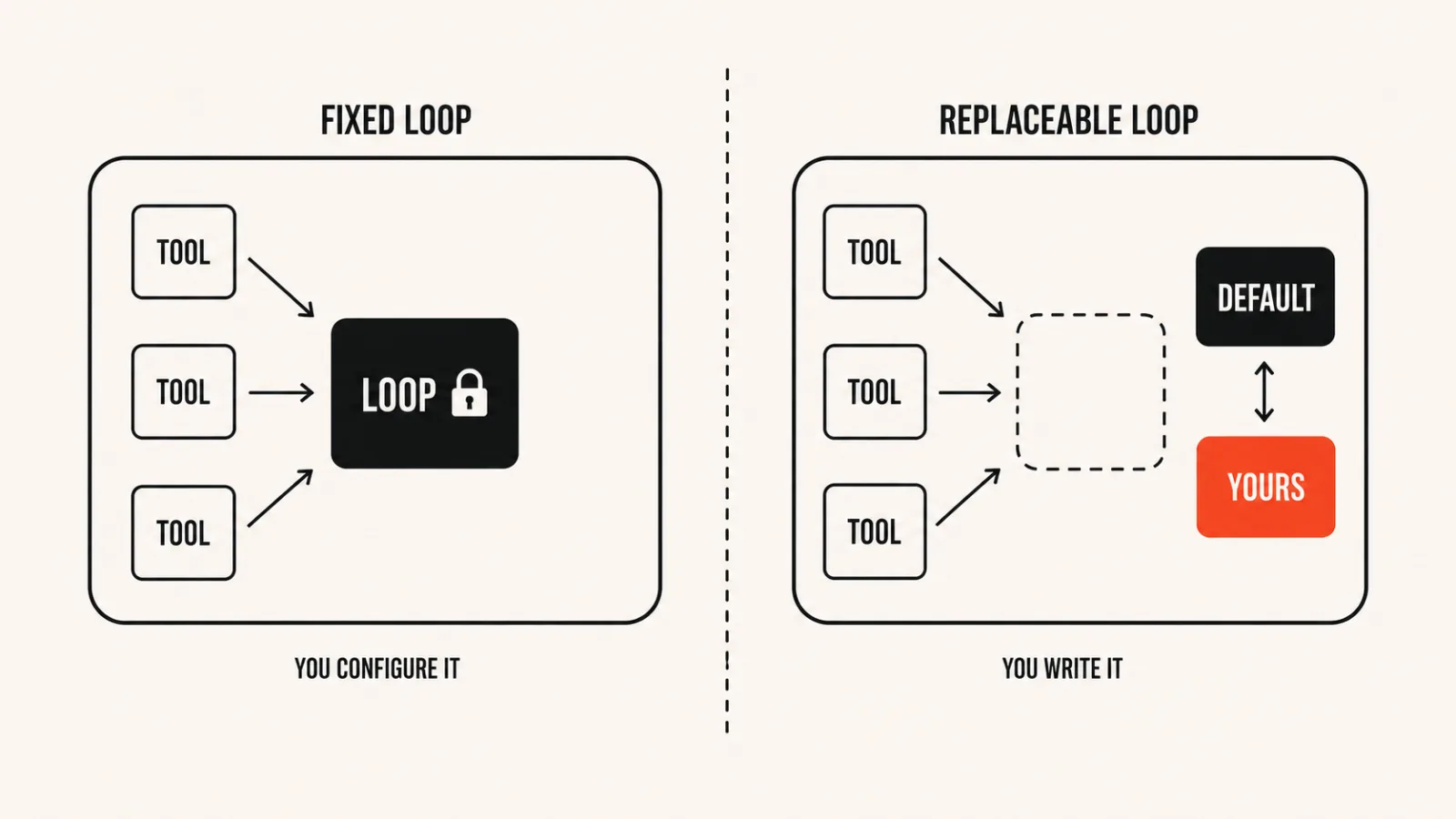
The fourth one is the unusual claim. In Claude Code, Codex CLI and most harnesses, the loop is the framework. It decides when to call a tool, when to think again, when to compact context and when to stop. You configure it. You do not replace it.
Making that a plugin means the harness is not asserting one opinion about how an agent should think. It is providing the plumbing and letting you bring the opinion.
Every agent framework lets you add tools. This one lets you replace the part that decides what to do with them. Those are very different offers.
Why that is interesting, and why it might not matter to you
The case for it. If you have tried to make a standard agent loop do something non-standard, you know the failure mode: you fight the framework. You want a loop that always runs a validation pass before finishing, or that escalates to a human on a specific tool result, or that plans in one model and executes in a cheaper one. Most harnesses make you approximate that with hooks. A replaceable loop makes it a first-class thing you write.
The case against it. A framework's opinion is usually worth more than you think, because it encodes a year of somebody else's production failures. Replace the loop and you own every bug in it. Claude Code's loop is proprietary and unswappable, and that is also why it works well without you touching it.
The honest read for most teams: the plugin architecture is a real differentiator, and most teams will never use the part that makes it different. If you are shipping standard agents, replaceability costs you nothing and buys you nothing. It matters when you have already hit a wall with a fixed loop and know exactly which behaviour you need.
How it compares
| DeepSeek Harness (dsh) | Claude Code | Codex CLI | |
|---|---|---|---|
| Licence | MIT | Proprietary | Open source |
| Language | TypeScript | TypeScript | TypeScript |
| Tools pluggable | Yes | Yes | Yes |
| Model adapter pluggable | Yes | No | Partly |
| Agent loop pluggable | Yes | No | No |
| Cheapest real path | Pay per token | $20/mo Pro | $0, ChatGPT free tier |
| Model rate per 1M | V4-Pro $0.435 in / $0.87 out | Sonnet 4.6 $3 / $15 | GPT-5.6 Luna $0.20 / $1.20 |
| Cached input per 1M | $0.003625 | Discounted | Discounted |
| Best for | Teams who need to own the loop | Predictable monthly bill | Lowest cost at zero |
The cost detail that matters more than the headline rate
V4-Pro is $0.435 per million input and $0.87 per million output, after DeepSeek made a 75% promotional cut permanent in late May 2026.
That output price is worth a second look. It undercuts GPT-5.6 Luna's $1.20, which was the cheapest output rate in our comparison of Grok Build, Claude Code and Codex CLI. Input is higher, at $0.435 against Luna's $0.20.
But the number that actually decides an agent bill is this one: cached input on V4-Pro is $0.003625 per million. That is roughly 120 times cheaper than a cache miss.
Coding agents are the ideal shape for this. They resend an enormous, largely unchanged context on every turn: the same files, the same instructions, the same conversation. If that context is cached, the dominant cost of an agent session mostly stops existing.
Which flips the usual comparison. Headline per-token rates describe a single call. Agent workloads are thousands of calls sharing one context, so cache pricing describes what you will actually pay. A model with a mediocre headline rate and an excellent cache rate can be far cheaper in practice than the reverse.
When to actually reach for it
Use it if you need to own the loop. You have hit a real wall with a fixed harness, you know the behaviour you need, and you are prepared to maintain it. MIT means no licensing conversation.
Use it if cache economics dominate your bill. Long sessions over a stable codebase are exactly the workload the cache pricing rewards.
Do not use it because of the star count. It is reported five different ways by four outlets, and none of them is a measure of whether the thing is production ready.
Do not use it as a Claude Code replacement without testing. It launched on 13 August 2026. Whatever its architecture, it has weeks of production exposure against competitors with a year or more. That is not a criticism, it is a fact about age.
Common mistakes
Treating GitHub stars as an adoption signal. Reports for this repo span 33,000 to 165,000 depending on who you read. Stars measure attention, and this launch generated an unusual amount of it.
Assuming a replaceable loop is free. Replace it and you own its correctness, its edge cases and its context handling. The default loop in a mature harness is a liability someone else carries.
Comparing headline token prices for agent work. Agents resend context constantly. Compare cached input rates, because that is where the money goes.
Confusing MIT licensing with cheap to run. The harness costs nothing. Every token still bills. This is the same trap as calling an open source coding agent free when the model behind it is not.
Adopting a two-week-old harness for client work. It may well be excellent. It has not yet been wrong in enough different ways for anyone to know where it breaks.
Key takeaways
- DeepSeek Harness (
dsh) launched 13 August 2026, MIT licensed, TypeScript, built on the Cordis runtime. - Four components are replaceable plugins: the model adapter, the tool registry, the session log, and the agent loop itself.
- The swappable agent loop is the genuine differentiator. Claude Code and Codex CLI both keep the loop fixed.
- Most teams shipping standard agents will never use that capability. It pays off only once a fixed loop has actually blocked you.
- Star counts for this repo are reported as 33,000, 64,000, 95,000 and 165,000 by different outlets. Treat the number as unverified.
- V4-Pro is $0.435 per million input and $0.87 output, so its output rate undercuts GPT-5.6 Luna.
- Cached input is $0.003625 per million, roughly 120 times cheaper than a miss. For agent workloads that resend context constantly, cache pricing decides the bill more than the headline rate does.
If you are choosing a harness rather than reading about one, our comparison of the agent frameworks covers the layer this sits in, and testing whether the agent actually works matters considerably more than which harness you picked.