

You quoted a flat fee. Two weeks of work, a number you were happy with, the client said yes.
Then the automation went live and started saving them eleven hours a week. Every week. Forever. You got paid once.
Meanwhile Intercom charges 99 cents every single time its agent resolves a ticket, and Salesforce charges two dollars a conversation. They built the thing once too.
The gap between those two business models is the whole subject of this post. It is also where most agency pricing advice goes wrong, because it is written for SaaS vendors with a million conversations a month, and you have one client with an unknown number.
What the AI vendors actually charge
Start with the market, because clients read the same articles you do and arrive with these numbers already in their head.
| Vendor | Model | Rate | What counts as billable |
|---|---|---|---|
| HubSpot Breeze | Per resolution | $0.50 | A resolved conversation |
| Aissist | Per resolution | about $0.60 | A resolved conversation |
| Gorgias | Per resolution | $0.90 to $1.00 | A resolved ticket |
| Intercom Fin | Per outcome | $0.99, 50/month minimum | Resolution, handoff or disqualification. Lead qualification is $9.99 |
| Sierra | Per outcome, blended | about $1.50, unpublished | Resolution, saved cancellation, completed transaction |
| Zendesk | Per resolution | $1.50 to $2.00 | A resolved ticket |
| Salesforce Agentforce | Three models at once | $2 per conversation, or $500 per 100,000 Flex Credits, or from $125 per user | A conversation is a 24 hour session. A standard action is 20 credits, about $0.10 |
Two things stand out.
The per-resolution band is narrow. Nearly everyone lands between $0.50 and $2.00. That is not a coincidence, it is a market that has converged.
Salesforce ships three models at once. Per conversation, per credit, per seat. When the largest vendor in the category cannot pick one, buyer preference is not settled either, and you are allowed to offer a choice.
When Salesforce ships three pricing models for one product, that is not indecision. It is an admission that buyers do not agree on what they are buying.
The contrast that should decide your model
Two vendors in the same category, priced on opposite principles.
Sierra bills on outcomes. You pay when the agent resolves the conversation, saves the cancellation, completes the transaction.
Decagon bills on conversation volume and automation depth. You pay for activity.
Sierra's model punishes Sierra when the agent fails. Decagon's model pays Decagon either way.
That is the only question that matters when you pick a model for a client build: what does this contract pay me to optimise? Bill for hours and you are paid to be slow. Bill per run and you are paid for volume the client may not want. Bill per outcome and you are paid only when the thing works, which sounds virtuous right until you meet the problem in the next section.
Why outcome pricing works for them and not for you
Every vendor above has something you do not: volume.
Intercom charges $0.99 per resolution across millions of resolutions. Some cost them more than a dollar in inference, some cost a fraction of a cent. It averages out. That is insurance, and insurance only works at scale.
You have one client. If the automation resolves 200 tickets in month one and 40 in month two because their traffic dropped, you absorbed a variance you were never paid to carry. You are not a portfolio, you are a single bet.
Three more problems specific to agency work.
Attribution. Intercom knows a ticket was resolved because their agent closed it. Your client's savings run through their staff, their tools and their process changes. When revenue rises, their marketing lead will have a view on why, and it will not be your automation.
Measurement access. Outcome billing needs a number both sides trust, pulled from a system you may not control after handover. If you cannot query it, you cannot invoice on it.
Cash flow. Outcome revenue arrives months after the build. Payroll does not wait.
Outcome pricing is insurance, and insurance only works across a portfolio. One client is not a portfolio, it is a bet.
The four models, and what each does to you
| Model | You get paid for | Works when | Fails when |
|---|---|---|---|
| Hourly | Time spent | Scope is genuinely unknown | You get fast. Efficiency cuts your own revenue |
| Flat project fee | The deliverable | Scope is clear and the build ends | The automation runs for years and you were paid once |
| Pure outcome | Results delivered | You have volume and clean attribution | One client, disputed measurement, slow cash |
| Hybrid | Build plus a share | Almost always, for agency work | The client will not share the measurement |
Hourly and pure outcome are the two extremes and both are wrong for most agency builds. Hourly pays you to be slow. Pure outcome asks you to underwrite a risk you cannot diversify.
How to structure a hybrid that holds up
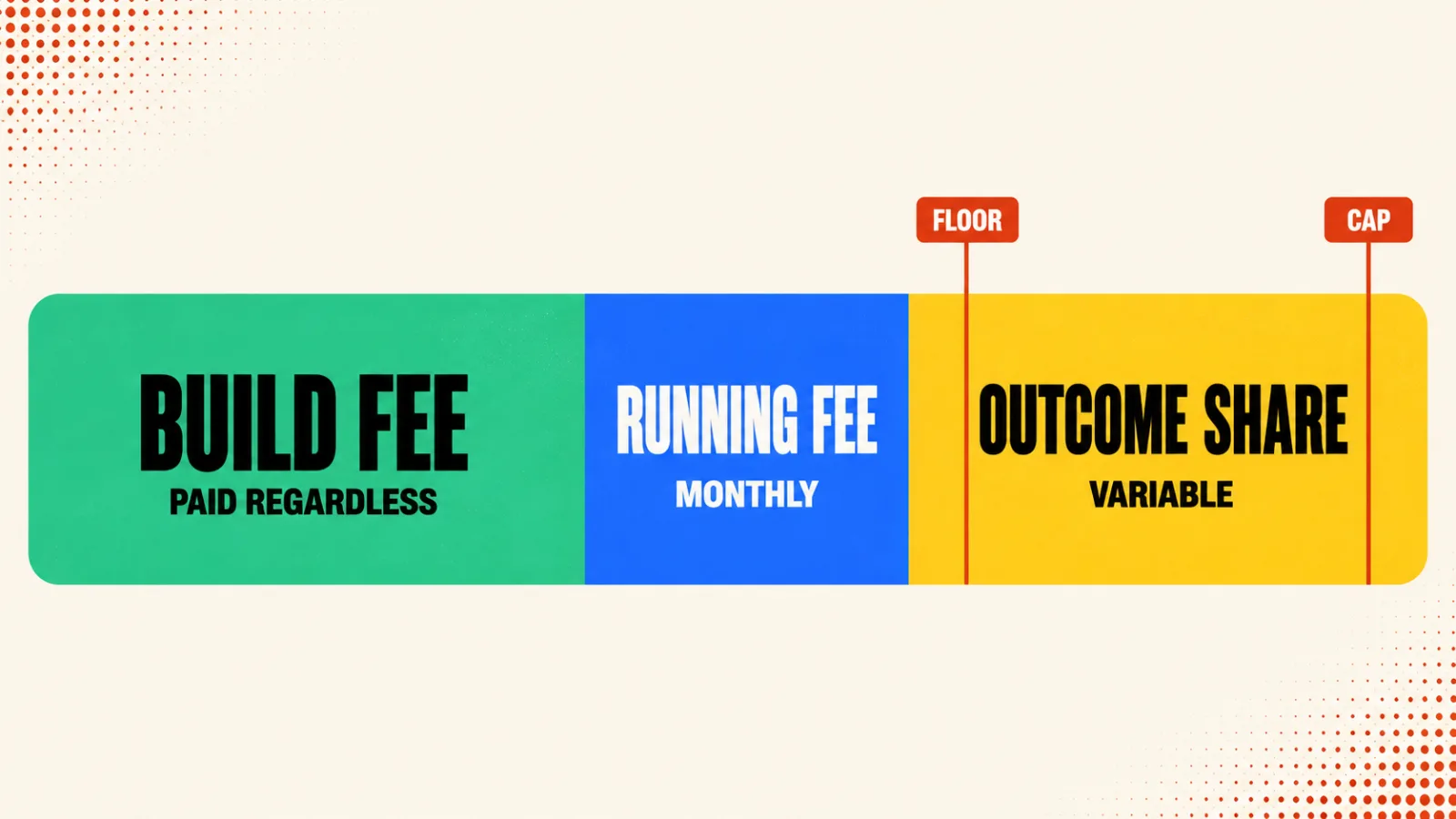
Four components, and you rarely need all four.
1. A build fee that covers the work on its own. This is the floor, not a deposit against future outcome revenue. If every outcome component pays zero, the build fee must still have made the project worth doing. Anything else is lending the client money at zero interest.
2. A running fee for the part that keeps costing you. Automations need monitoring, model updates and fixing when an upstream API changes. That is a real ongoing cost so it needs a real ongoing line. Keep it separate from the outcome component, so a bad month does not stop you maintaining the thing.
3. An outcome component tied to one number you can both query. One, not a dashboard of five. Pick the metric closest to the automation and furthest from anyone else's work:
- Tickets resolved without a human touching them
- Invoices processed end to end
- Qualified leads that reached the CRM
- Hours logged against a process the automation now runs
Avoid revenue. It is the number with the most other people's fingerprints on it, and the one you will lose an argument about.
4. A cap and a floor. The cap protects the client, who will otherwise refuse to sign something with unbounded upside for you. The floor protects you from a quarter where their traffic collapsed for reasons unrelated to your build. Both parties sleep better and the contract gets signed faster.
What to ask before you quote anything
You cannot price an outcome nobody has measured. Four questions, on the first call:
- What does this process cost you today? In hours, headcount or vendor spend. If they cannot answer, there is no baseline and no outcome model is possible yet.
- Who owns the system the number lives in? If it is a tool you lose access to at handover, that number cannot be your billing basis.
- What happens to the saved time? Redeployed or removed. This changes the value enormously, and it changes who inside the client wants your project to succeed.
- How long do you expect to run this? A two year horizon justifies a different structure from a campaign that ends in March.
If the answers are vague, quote a flat fee for a scoped build and revisit. A hybrid built on numbers nobody has measured is worse than a clean fixed price.
Common mistakes
Treating the build fee as a deposit. If your build fee only makes sense assuming outcome revenue arrives, you have taken equity risk on a services margin. Price the build so it stands alone.
Billing on revenue. The most attractive number and the least defensible. Every other department will claim credit for it, and you are the outside vendor in that argument.
Copying a SaaS rate card. $0.99 per resolution works across millions of resolutions. Applied to one client's 300 tickets a month it is $297, which will not cover the monitoring, let alone the build.
No cap. Clients do not fear paying you fairly, they fear an invoice they cannot forecast. An uncapped share is the fastest way to turn a signed deal into a legal review.
Forgetting your own inference costs. Bill a fixed monthly fee, then watch the client's volume triple: your model costs triple and your margin goes negative. Tie a usage floor to the running fee, or pass model costs through at cost.
Key takeaways
- The market has converged on $0.50 to $2.00 per resolution. Intercom Fin is $0.99, Zendesk is $1.50 to $2.00, Agentforce is about $2 per conversation.
- Salesforce ships three pricing models for one product, so buyer preference is not settled and you can offer a choice.
- Sierra bills on outcomes and Decagon bills on activity. Whatever you bill on is what the contract pays you to optimise.
- Outcome pricing is insurance that only works across a portfolio. One client is a bet, not a portfolio.
- Use a hybrid: a build fee that stands alone, a monthly running fee, one outcome metric, and both a floor and a cap.
- Never bill on client revenue. Pick the number closest to your automation and furthest from everyone else's work.
- If the client cannot say what the process costs today, there is no baseline. Quote a flat fee and revisit.
We quote a fixed price and a date after one call rather than publishing a rate card, for most of the reasons above: the right structure depends on what the process costs today and who owns the number. If you want that conversation about your own process, that is what we do. And if you are still choosing the stack underneath it, our comparison of n8n, Zapier and Make works through what each one costs to run.